






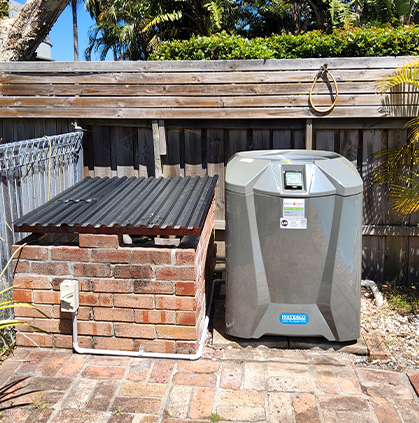

Want to heat your pool more effectively with rooftop solar? Pool heat pumps and solar PV integration can help you get more value from your panels.
These pumps use solar energy during the day to warm your pool, costing less than grid power. But it’s only worth it if your system is big enough.
In this article, we’ll show you how to check your capacity first, before calling a pool heating installation expert.
How Pool Heat Pumps and Solar PV Integration Works
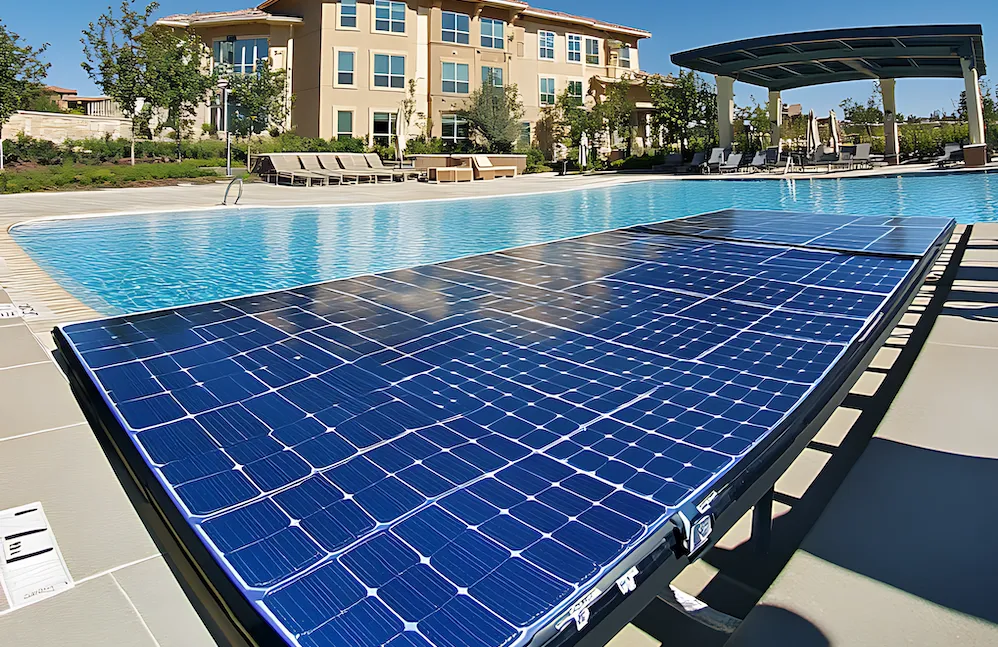
Image: nattysiri on Magnific
Pool heat pumps and solar PV integration combine two technologies into one efficient, low-cost system.
A heat pump pulls warmth from the air and sends it to your pool. It uses electricity to run the compressor, fan, and refrigerant cycle.
With solar PV panels, you turn sunlight into electricity, so you can get “free” power during the day, when your pool needs the heat most.
With a smart controller, solar electricity powers the heat pump in real time, turning sunlight directly into pool heating and reducing grid use to nearly zero.
In Australia, standard pool heat pumps typically use 3–6 kW to keep water warm, which can be costly if run fully from the grid.
With this combined system, sunlight powers the pump, and the pump moves heat in cycles. This cuts operating costs, boosts energy independence, and keeps your pool warm all season.
The key is that each device helps balance the other’s limits, either by:
- Passive (timer-based) integration: set the heat pump to run when solar output is highest. No direct system communication.
- Active (PV-ready) integration: the heat pump monitors solar pool heating output and adjusts operation to match the electricity available.
The passive method is simple, but active integration can save you more money. We’ll cover that later.
Understanding COP: Why Heat Pumps Are Ideal for Solar Pairing
COP (Coefficient of Performance) measures the efficiency ratio of how much heat your pool heat pump produces for each unit of electricity used.
A COP of 5 means 1 kW of electricity becomes 5 kW of heat. This is far more efficient than a direct electric heater, which produces only 1 kW of heat per 1 kW of power.
So, a higher COP means lower electricity use, and your solar PV can often cover most daytime running costs.
For example, a 17 kW heat pump with a COP of 5 needs just 3.4 kW of electricity. With a typical 6.6 kW Sydney system generating around 3–7 kW in daylight, your panels can power the pump largely on free energy.
But keep in mind that COP varies with air temperature. Heat pumps perform best at 26 °C, but Sydney winter often sits around 15–18 °C, which is not the ideal pool temperature, where COP drops to about 3.5–4.
Even then, you still get about triple the heat for the same power, so heat pumps are a great fit for solar.
How Much Solar Do You Need for a Pool Heat Pump?
It depends on the size of your heat pump, so you need to know how to size a pool heat pump. But, here’s a practical reference:
| Pool Heat Pump Size | Electricity Draw (Peak) | Minimum Solar PV System | Comfortable Match | Best Pairing |
|---|---|---|---|---|
| 6 kW | 1.2–1.5 kW | 3.3 kW | 5 kW | 5–6.6 kW |
| 10 kW | 2–2.5 kW | 5 kW | 6.6 kW | 6.6–10 kW |
| 13 kW | 2.5–3 kW | 6.6 kW | 8 kW | 8–10 kW |
| 17 kW | 3.5–4 kW | 8 kW | 10 kW | 10–13.2 kW |
| 20 kW | 4–5 kW | 10 kW | 13.2 kW | 13.2–16.5 kW |
| In Sydney, a 13 kW pool heat pump is a great match for solar. Even though it’s rated at 13 kW, you’ll only use about 2.5–3 kW. |
Run the pump from 10 am to 3 pm. With a 6.6 kW solar system, you can run it for free during those hours. In over four hours, you’ll get 10–12 kWh of heating each day, saving you $3–$4 a day, or $1,000–$1,500 a year.
If you have a bigger pool or want to swim from October through May, go with a 17 kW heat pump. It uses about 3.5–4 kW, which is only 20% more than the 13 kW model, but gives you much more heat.
With a 6.6 kW solar system, you’ll cover 80–90% of your needs. For closer to 100%, choose an 8–10 kW system. This lets you run the pump from mid-morning to late afternoon using mostly your own power.
On a sunny day, if you run a 17 kW heat pump from 10 am to 4 pm with a 10 kW solar system, you’ll save about $4–$5 a day. Over a five-month season, that’s $600–$750 saved just by running it during the day.
But, do you need a huge solar setup for a heat pump to be worth it? No. You don’t need solar to cover everything, just enough to lower your bills.
PV-Ready and Inverter Heat Pumps: The Smarter Integration Option
Your choice depends on what you need. If you want something simple and cheap, choose a timer-based heat pump. If you want maximum efficiency and lower bills, a PV-ready inverter heat pump is a smarter investment.
With a timer, you just set a schedule. You program the pump to run during peak solar hours, usually 10 a.m. to 3 p.m. in Sydney. It’s reliable and doesn’t need extra hardware.
If you run a 13 kW pump for five hours, you’ll use about 12–15 kWh. A 6.6 kW solar system can cover that on a sunny day. But if it gets cloudy, your pump pulls power from the grid, which cuts into your savings.
PV-ready inverter heat pumps work differently. They watch your solar output in real time, speeding up when your panels make extra energy and slowing down when output drops.
A 17 kW pump using 3.5–4 kW can run almost entirely on a 10 kW solar system. These cost more upfront and need specific monitoring hardware, but you get better self-consumption and less manual work.
So, if you have a smaller system, consistent sun, or a tight budget, a timer-based control works well. But if you have a larger system, changing weather, or want full automation, go with a PV-ready inverter heat pump.
Running Cost Comparison: Grid Only vs Solar-Integrated in Sydney
Once you’ve chosen the right heat pump and solar size, the next question is: what will it actually cost to run?
| Grid Only | Solar-Integrated (6.6 kW system) | |
|---|---|---|
| Annual electricity cost | $600–$900 | $150–$300 |
| Estimated annual savings | — | $400–$650 |
Grid-only running cost: $600–$900 a year (at ~$0.30/kWh). Your 13 kW heat pump has a COP of 5, drawing 2.5–3 kW of electricity. Running it six to eight hours a day for a 180-day season consumes 2,000–2,400 kWh.
At Sydney’s average rate of 30 cents per kilowatt-hour, direct heating costs total $600–$720. Using more heat during June, July and August adds $100–$180, bringing your annual total to $600–$900.
Solar-integrated running cost: $150–$300/year. Pair your 13 kW heat pump with a 6.6 kW solar system and run it between 10 am and 3 pm. Your panels generate 4–5 kW, which covers the 2.5–3 kW the heat pump needs.
On sunny spring and autumn days, you’ll use almost no electricity from the power grid. In winter, you’ll need 500–800 kWh from the grid. At 30 cents per kWh, that costs $150–$240.
Choosing solar-integrated over grid-only systems costs $150–$300 versus $600–$900, saving you $400–$650 every year.
But, these are estimates. The actual costs depend on your system size, electricity plan, pool usage and cover. And you need to calculate this well whenever you choose a pool heater.
Solar Thermal vs Solar PV + Heat Pump: What’s the Difference?
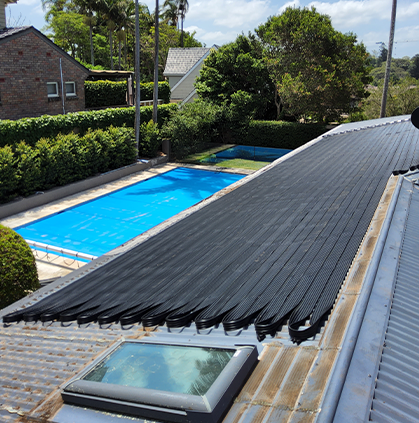
It is easy to confuse solar thermal and solar PV, as both use the sun to heat your pool. But, thermal panels use a network of tubes, while PV panels are made of silicon cells.
Solar thermal is the older technology. A pump pushes your pool water through rubber or plastic panels on your roof to heat it up directly. It uses less electricity than a standard heater, but you still need power to run the pump.
Solar PV and heat pumps work differently. Your roof panels turn sunlight into electricity to power your heat pump. The pump moves heat from the air into your water instead of creating it from scratch.
Think of it this way: solar thermal gives you direct heat, while solar PV gives you electricity to run your machines.
Solar thermal needs strong, direct sun, so you’ll often need a gas or electric booster. In contrast, solar PV makes power when it’s overcast, and modern heat pumps can pull warmth from the air even when it’s as cold as 8°C.
On top of that, solar PV is more flexible. It can power your pool, fridge, air-conditioning, and EV charger, while solar thermal collectors take up your roof space for just one job.
How about the cost? Solar thermal is cheaper to start, costing $3,000–$7,000. But if you want to save more on your energy bills long-term, go with a full solar PV and heat pump system.
| Solar Thermal | Solar PV + Heat Pump | |
|---|---|---|
| Upfront cost | Lower ($3,000–$7,000) | Higher ($10,000–$15,000+) |
| Running costs | Very Low (pump only) | Low (solar offset) |
| Year-round heating | Limited | Yes |
| Target temp range | ~28°C (weather-dependent) | 28–32°C consistent |
| Best for | Seasonal swimmers | Year-round use |
FAQ About Pool Heat Pumps and Solar PV Integration
Here are the questions Sydney pool owners most often ask us about running a heat pump on solar:
Can I connect my existing heat pump to my solar system?
Yes, any heat pump works with solar power by setting a timer for peak sunlight between 10 am and 3 pm. You don’t need a special PV-ready unit to save. While those models offer automated features, they aren’t required.
Will my pool heat pump drain my solar battery?
A pool heat pump uses 2.5–4.5 kW, which drains your batteries fast. To save power, run the pump during the day while your solar panels are active, and save your battery storage for your home.
How many solar panels do I need to run a pool heat pump?
A 13 kW heat pump pairs perfectly with a 6.6 kW solar system of 15–18 panels. If you need a 17 kW unit, you’ll want 6.6–10 kW of solar. Talk to a pool heating specialist to find the right setup for your pool size.
Is a pool heat pump more efficient than a gas heater when run on solar?
Gas heaters are about 80–85% efficient. A heat pump with a COP of 5 hits 500% efficiency, and if you power it with solar, your costs are basically zero. It’s not even a contest.
What happens on cloudy days or in winter?
Heat pumps rely on grid electricity when solar efficiency drops during Sydney’s winter. To lower costs, use a pool cover to prevent heat loss and set temperatures to 24–26°C rather than 28°C.
Conclusion
Pool heat pumps and solar PV integration is one of the best pairings in a Sydney backyard. The electricity your panels produce during the day is worth three times more when it powers your heat pump.
The sizing tables in this guide are a good place to start. But to get your setup right, look at your pool volume, how you’ll use it, and the real solar output.
Need your pool heated? The team at Lightning Bult can check your system, recommend the best heat pump, and handle installation across Sydney. Contact us to learn how your solar panels can power your pool heating better.