





A small part in your pool heat pump can quietly double your power bill if it fails. That part is the reversing valve.
What is the reversing valve on a heat pump? It’s the valve that switches your system between heating and cooling. When it breaks, the pump runs nonstop without warming the water.
This guide covers how it works, warning signs to watch for, and when to call a pool heating service before small issues become costly repairs.
What Is a Reversing Valve on a Heat Pump?
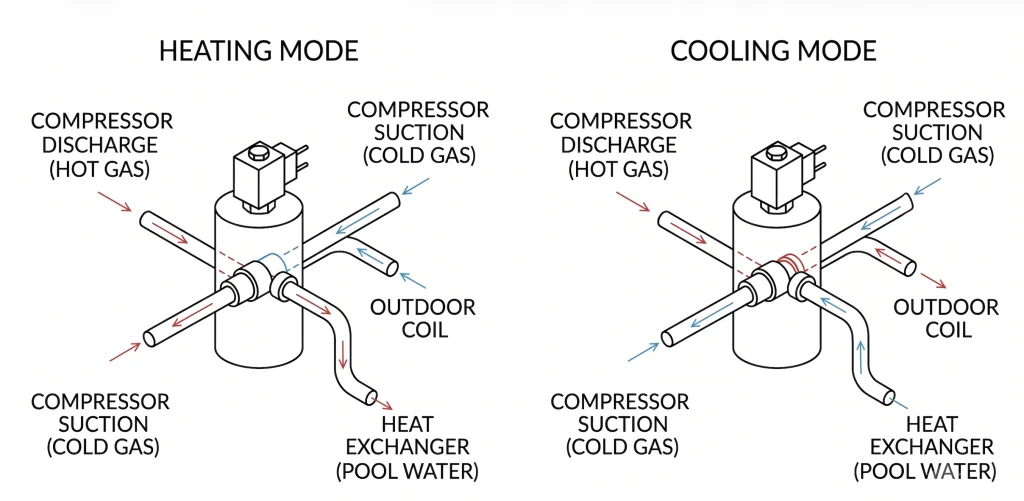
A reversing valve is a four-port switch inside your pool heat pump. It directs refrigerant after the compressor turns it into hot, high-pressure gas.
The four ports connect the compressor discharge line, suction return line, outdoor evaporator coil, and pool heat exchanger.
In heating mode, the valve sends that hot gas into the pool heat exchanger to warm your water. In cooling mode, it flips the path, sending the hot gas to the outdoor coil to release heat into the air.
Most Sydney pool heat pumps spend almost all their time in heating mode, but the valve still needs to shift properly.
If it doesn’t, your unit might get stuck in the wrong mode, fail to defrost, or run for hours without changing your pool temperature.
Think of the reversing valve like a railway switch and the refrigerant like a train. One track sends heat into your pool. The other sends it outside to cool or defrost.
If the valve sticks, the internal spool won’t move all the way. If it leaks, refrigerant slips past the spool and takes the wrong path, even if the valve looks like it switched.
How Does a Reversing Valve Work?
A reversing valve changes the refrigerant path in your pool heat pump. Here is how it works:
- Refrigerant absorbs heat from outdoor air — Refrigerant flows through the outdoor coil, a metal grid exposed to outside air. Even at 10°C, the air contains enough heat for the refrigerant to absorb. That’s the basic idea of how a heat pump works.
- The compressor pressurises the refrigerant — Low-pressure refrigerant carrying absorbed heat enters the compressor. Pressure and temperature rise rapidly as electricity powers the compressor, turning it into hot, high-pressure gas.
- The reversing valve directs the heat —In heating mode, the valve stays in its default position. The solenoid coil gets no power. It sends hot compressed refrigerant straight to the heat exchanger, where the heat moves into your pool water. That’s how your pool gets to 26 to 28°C.
- An electrical signal shifts the valve for defrost — When the outdoor coil gets too cold, frost builds up. A solenoid shifts a pilot valve, moving the reversing valve’s main spool. This redirects hot gas to the outdoor coil, melting frost before airflow drops too far.
- Defrost ends, heating resumes — Once the coil clears, the valve returns to heating mode. Hot refrigerant flows back to the pool heat exchanger, and the pool warms again.
Note: Manufacturers wire the reversing valve differently. Some use an O terminal (energised for cooling), others use a B terminal (energised for heating). The mechanism stays the same, only the default position changes.
Why the Reversing Valve Matters for Pool Heating
Sydney pools never get freezing cold. In June and July, they sit at 14 to 16°C. The target is 26 to 28°C. The heat pump must bridge that gap. To keep the pool warm through winter, the valve must perform in four critical areas:
- Reliable heating — The reversing valve must stay in the heating position on the coldest nights, when wind and radiation cause the most heat loss. If a valve leaks or gets stuck, refrigerant goes the wrong way, so less heat reaches the pool heat exchanger.
- Direct impact on costs and efficiency — Your pool heat pump efficiency is measured by its COP (Coefficient of Performance). A working reversing valve keeps refrigerant flowing correctly, with COP values of 5 to 13. A leaking or stuck valve sends refrigerant the wrong way—lowering COP, and raising bills.
- Defrost cycle execution — Defrost performance depends on the valve. When the outdoor coil ices, the reversing valve must shift to let hot gas melt the frost. Incomplete reversal leaves ice, blocks airflow, and causes longer defrost cycles.
- Compressor protection — A stuck or leaking valve forces your compressor to pump against conflicting pressures. This mechanical stress shortens compressor life, turning a valve issue into an expensive system replacement.
Key Components of a Heat Pump Reversing Valve
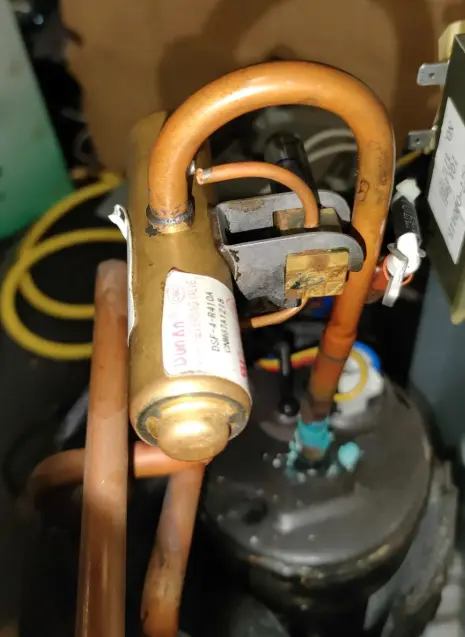
Image: Reddit.com
A heat pump reversing valve needs five parts to work together. If one part fails, the system loses control:
1. The Main Valve Body
You’ll find the main valve body inside your outdoor unit, usually right by the compressor. Think of it as the system’s traffic controller.
It’s a heavy brass cylinder with four large copper ports brazed onto it. Inside, there’s a sliding assembly made of two end pistons connected to a central block.
When the valve switches, that block slides sideways just like a railway switch. It opens one path and seals off another.
2. The Electromagnetic Solenoid
The solenoid is a small, plastic-covered coil on the outside of your valve. It’s tiny, but it’s the main trigger.
Inside, there’s tightly wound copper wire. When your thermostat or control board needs a mode change, it sends a 24V AC low-voltage signal to the coil.
This creates a magnetic field that pulls a small plunger to start the valve shift. The solenoid doesn’t move the main slider itself; it just starts the pilot valve movement.
And coils can burn out over time. A healthy coil should read between 15 and 65 ohms, depending on your valve model.
3. The Pilot Valve
The pilot valve is the small brass piece on your main reversing valve. It’s the middleman between the electricity and the refrigerant pressure.
The solenoid just moves a tiny steel slide inside this valve. Once that slide shifts, it sends a bit of high-pressure gas into the control circuit.
The pilot valve doesn’t handle the full refrigerant load for your pool heat exchanger or outdoor coil. Instead, it controls the pressure that moves the main slider, which is why it’s so important for the reversing process.
If the pilot valve sticks, your main valve won’t shift properly. You’ll notice weaker heating, longer defrost cycles, and strange pressure readings.
4. The Capillary Tubes
The three thin copper tubes run along the outside of the reversing valve. They look like straws next to the main pipes.
These tubes connect the pilot valve to both ends of the main valve body. They move high-pressure refrigerant gas into one side of the brass cylinder while letting pressure out of the other.
When the pilot valve opens the right path, refrigerant pressure pushes against one end piston while the other side vents. This makes the main slider snap into the heating or defrost position.
If a capillary tube gets blocked, cracked, kinked, or leaks, it ruins that control sequence.
5. Suction and Discharge Lines
The suction and discharge lines are the four heavy-gauge copper pipes that connect the reversing valve to the heat pump’s refrigeration circuit.
The discharge line moves superheated, high-pressure gas from the compressor into the top port of the valve. The suction line pulls cold, low-pressure vapor from the center bottom port back to the compressor.
The two side lines connect the valve to the outdoor air coil and the pool water heat exchanger. These connections have to handle heat, vibration, pressure, and the weather.
Image: Amazon.com Robert Davis
Signs Your Pool Heat Pump Reversing Valve May Be Failing
Reversing valve problems show up fastest in cooler months when the pool needs heat. Here are six signs to know:
1. Pool Won’t Reach Target Temperature
Your heat pump runs for hours. The fan spins and the compressor sounds like it’s working. But, the pool stays at 18°C to 20°C instead of reaching your target of 26°C to 28°C.
This is a classic sign of a reversing valve problem. If the valve gets stuck, the refrigerant can’t flow the right way, which means less heat reaches the pool heat exchanger.
There is no loud noise or obvious failure. The system looks like it is working, but your pool heat pump is not heating.
2. System Stuck in Cooling or Defrost Mode
Your pool temperature drops while the heat pump is running? It shouldn’t happen in heating mode.
A stuck reversing valve can trap your unit in cooling or defrost mode. So, instead of sending heat to your pool, it sends it to the outdoor coil.
And you can check this by feeling the air coming out of the unit. If it stays in defrost mode for too long or never switches back to heating, the reversing valve belongs high on the suspect list.
3. Hissing or Unusual Refrigerant Noise
If you hear a sharp hiss near the valve assembly, it isn’t normal fan noise or compressor hum. It usually means refrigerant is leaking past the internal spool instead of flowing through the circuit.
This internal bypass wastes heat inside your machine. Your compressor keeps running, but part of its work just loops uselessly.
Listen near the cabinet, especially when the unit changes modes or defrosts. A healthy valve shift sounds like a quick, mechanical click. If you hear a constant hiss, you have a problem.
4. Higher Running Costs Without Explanation
“Same pool, same routine. So why is your bill higher?” When you’re choosing a pool heating system, this is usually the biggest factor that changes your mind.
This can happen to your pool heat pump. It’s a common sign that your reversing valve has a problem.
When this valve is weak, your compressor has to work overtime because the heat exchanger isn’t getting enough heat. Your system runs longer, uses more electricity, and still struggles to warm the water.
It’s an expensive problem, but don’t replace the whole unit yet. Have a pro test the reversing valve and solenoid first. People often blame the compressor or the size of the heat pump, but it’s usually just the reversing valve.
5. Defrost Cycle Running Too Often or Not at All
It’s normal to see a little frost on your outdoor coil during a Sydney winter, but it shouldn’t be there all the time.
If your system triggers a defrost every 30 to 45 minutes, the valve might be struggling to shift or leaving ice behind. If frost builds up overnight and never clears, the valve might not be defrosting at all.
Either way, this hurts your system. Ice blocks airflow, which stops the unit from absorbing heat properly. This forces your compressor to work longer, makes your pool heating weaker, and wears out your equipment faster.
6. Constant Short Cycling
If your heat pump turns on and off every few minutes, it is short cycling. This happens when a stuck reversing valve causes abnormal refrigerant pressure
This forces the control board to cut power to protect the compressor. While this safety feature prevents damage, it stops your unit from heating effectively.
If you notice short cycling along with poor heating, strange noises, or defrost faults, the reversing valve is no longer a minor suspect.
Can You Fix a Reversing Valve Yourself?
You can’t. The valve is part of the sealed refrigerant circuit, the Ozone Protection and Synthetic Greenhouse Gas Management Act requires an ARCTick licence for repairs.
It’s illegal to open the circuit without a license, and doing so will void your warranty and insurance. But, you can handle these basic checks:
- Make sure the thermostat is set to heat and the unit has power.
- Listen for a click when changing modes.
- Clean debris from outside coils.
For other problems, hire a professional technician. They will first test the solenoid coil using a multimeter and a 24V AC signal. If the coil is broken, it is a simple fix that costs $600–$1,000.
If the valve itself is stuck or leaking, it needs a major repair. This involves removing the refrigerant, welding in a new valve, testing the pressure, and refilling the gas. Expect to pay $400–$1,500+ for this service.
Image: Amazon Aquastrong
FAQ about Reversing Valve on Pool Heat Pumps
These are the common questions people often ask about reversing valves on full heat pumps:
How long does a reversing valve last?
Modern reversing valves last 10 to 15 years with proper maintenance. Early failure usually comes from a voltage spike burning the solenoid, refrigerant contamination, or improper installation torque.
How do I know if it’s the solenoid coil or the full valve body?
Have your technician test the solenoid coil with a multimeter. If it’s not 15–65 ohms or doesn’t click at 24V, the solenoid is bad. Swap it to avoid refrigerant recovery. If the coil works but the spool won’t shift, the valve body has failed.
Can a heat pump work without a reversing valve?
Technically yes, but only in one mode, permanently. If your reversing valve fails, it stays stuck. If it’s stuck in defrost, your pool won’t heat. If it’s stuck in heating, frost builds on the outdoor coil and chokes the airflow.
Is the reversing valve different in an inverter pool heat pump?
No. Valves, solenoids, pilot functions, and four-port setups are identical in both standard and inverter pool heat pumps. The only difference is the compressor. Inverters use variable-speed modulation rather than simple on/off cycling.
Conclusion
The reversing valve is a small but vital part of your pool heat pump. If your pool won’t heat up, your system might be stuck, or your power bill could be spiking.
Catching the issue early prevents damage to the compressor. A simple solenoid coil fix is much cheaper than replacing the entire valve.
Think your reversing valve is failing? Book a Lightning Bult expert online for a no-obligation assessment. Our ARC-tick-certified team serves Sydney’s Eastern Suburbs, Inner West, North Shore, Northern Beaches, along with their local suburbs like Queenscliff, Seaforth, and Terrey Hills.
Enquire today!