




Choosing the best pool heater for inground pools can feel confusing. Every option sounds right until the water still feels too cold to enjoy.
Gas seems fast, solar sounds cheap, and heat pumps look efficient. But which one keeps your pool comfortable at a reasonable cost?
This guide helps you compare comfort, speed, performance, and pool heating installation costs before choosing. Read on!
The 3 Best Pool Heater Options for Inground Pools
You have three main options for pool heating: heat pumps, gas, and solar pool heating. All can heat an in-ground pool, but none suit every house.
1. Pool Heat Pump
- Best for: regular pool owners wanting cost-effective year-round heating.
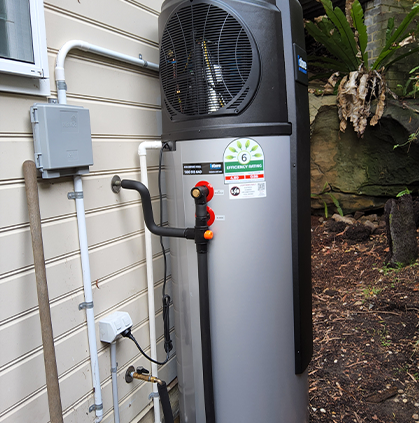
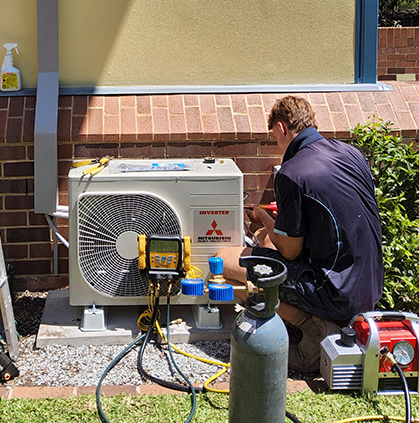
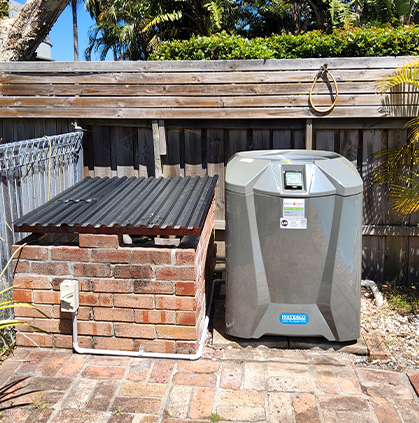
A pool heat pump works like a reverse-cycle air conditioner. It uses refrigerant coils and a heat exchanger to pull heat from the outside air and transfer it into your pool water.
It doesn’t create heat like gas. That’s what makes it efficient. It can deliver more heat energy than the electricity it uses. And its Coefficient of Performance (COP) shows it.
COP measures heat output against electricity used. Some models can reach a COP of 5 to 13 under certain conditions. That means for every 1 kW of electricity, you can get 5 to 13 kW of pool heat.
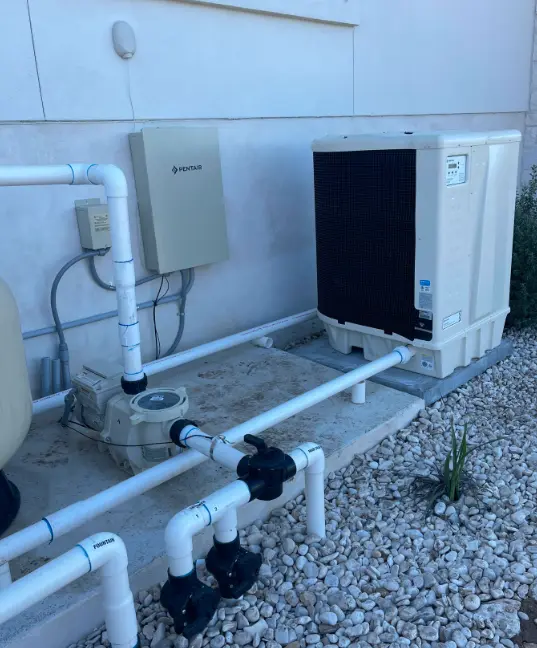
Image: Reddit.com @tomcruiselol
For a Sydney in-ground pool, heat pump pool heating is ideal for regular swimming. Daily or weekend swims. It keeps water warm most of the season without burning gas for every small temperature drop.
And what about the cost? In Sydney, a standard installation costs between $4,500–$9,500. And prices go up if you need a larger unit, complex wiring, or upgrades to your electrical switchboard.
Even so, you can save money on running costs, which are estimated at $250–$750 per year. For comparison, gas pool heating can cost $1,200–$3,500 per year.
2. Gas Pool Heater
- Best for: occasional pool owners, spa heating, or pools unused for weeks.
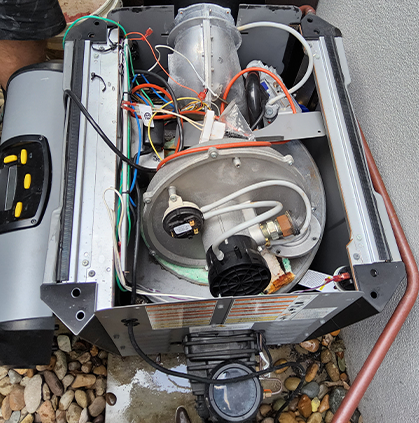
A gas pool heater burns natural gas or LPG and pushes heat through a heat exchanger into the water. Among pool heaters for inground pools, gas is the fast option.
If the pool stays cold all week and you want it warm by Saturday, gas heats faster than a heat pump. It also suits pool-and-spa combos where quick heat-up matters more than low hourly cost.
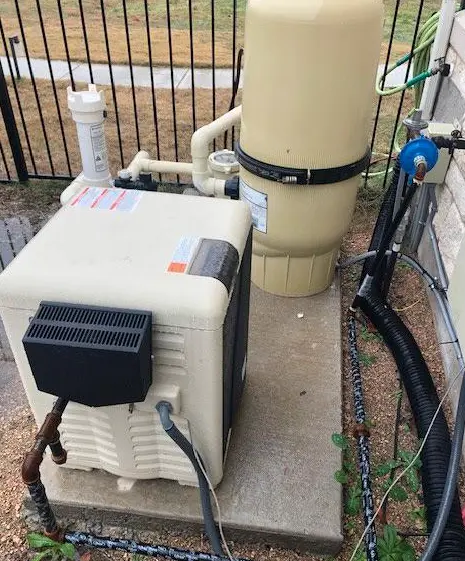
Image: Reddit.com @jst1265
But remember, gas pool heating with certified installation can cost $5,000–$10,500. The final price can rise if you need extra gas line work, a longer connection, or upgrades to suit the heater size.
Then there is the running cost. Gas bills include usage rates (cents per megajoule) and daily supply charges, varying by retailer, network, tariff, and usage block.
A 300 MJ unit burns about 300 megajoules per hour, costing $12–$16 per hour. Regular use can add $500–$1,500 per year.
Gas isn’t the cheapest for daily heating, but it works best for the right reasons. Its key advantage over heat pumps and solar is weather independence. It works in cold, cloudy, or winter conditions.
3. Solar Pool Heating
- Best for: pool owners in sunny Sydney suburbs with a north-facing roof and low shade.
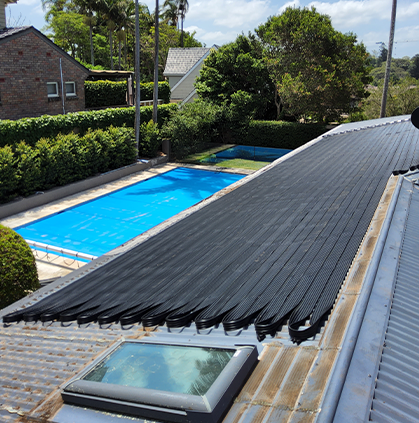
Solar pool heating pumps water through roof-mounted collectors. The sun warms the water inside, then it returns to the pool. Simple system.
For Sydney homeowners who swim in spring, summer, and autumn, solar heating works. With a sunny roof, good position, and low shade, it extends the swimming season without raising your power bill.
The pump still uses electricity, but the heat itself comes from the sun. That is why solar can be one of the most affordable heating options to run for an inground pool.
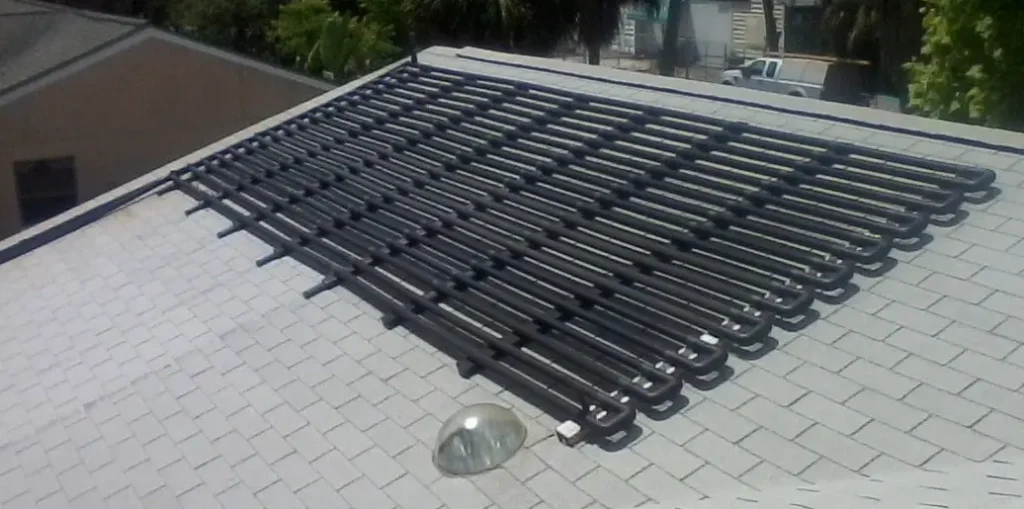
Image: Reddit.com
Solar pool heating installation cost is about $2,500–$6,000 for most home systems, depending on pool size, roof layout, and collector type. After installation, running costs can be under $1 a day.
But, solar works well only with sufficient collector area. Australian Standard AS3634 sets a 60% collector-area reference under ideal Sydney and Newcastle conditions, while SPASA recommends 80% for most installations.
So if your pool is large, you need a roof that can handle it. A large in-ground pool needs a big collector field. If your roof faces the wrong way, is shaded, or already has solar panels, solar pool heating might not work well.
Side-by-Side Comparison: Best Pool Heater for Inground Pool — Sydney 2026
| Pool Heat Pump | Gas Pool Heater | Solar Pool Heating | |
|---|---|---|---|
| Upfront Cost (installed) | $4,500–$9,500 | $5,000–$10,500+ | $3,000–$7,000 |
| Running Cost (annual) | $400–$800 | $1,200–$3,500+ | Under $100 |
| Heat-Up Speed | 24–48 hrs (+10°C) | 4–10 hrs (+10°C) | 1–3°C per day |
| Works in Sydney Winter? | Yes (with cover + timers) | Yes | Limited (May–Aug) |
| Lifespan | 10–20 years | 5–10 years | 10–25+ years |
| Best For | Regular year-round use | Occasional / rapid / spa | Sunny shoulder season or hybrid |
| 10-Yr Total Cost (approx.) | ~$12,000–$17,500 | ~$18,000–$41,500 | ~$4,000–$8,500 (standalone) |
Indicative figures for a 50,000 L Sydney inground pool with a cover. Gas costs based on NSW natural gas at 3.5–5 c/MJ. Heat pump costs based on ~35 c/kWh electricity. Actual costs vary with pool size, usage, and tariff.
Pool cover impact deserves its own call-out. A quality solar blanket cuts heat loss by 50–75%.
For heat pumps, that’s the difference between a bill you can handle and one that hurts. For solar systems, it gives you a much longer season that works.
You can learn more about solar vs heat pump comparison if the data above hasn’t given you enough information yet.
How to Choose the Best Pool Heater for Your Inground Pool
With three solid options, the right pool heating options depends on four questions about your pool use:
- How often you swim
- How much you want to spend upfront
- Which months you use the pool
- How much water the heater must move
1. How Often Do You Use Your Pool?
Daily and weekly swimmers should start with a heat pump. It warms the pool slowly and keeps the temperature steady for regular use.
Weekend-only swimmers don’t need a heater running all week. Gas suits that pattern with fast heat on demand—cold Friday, swimmable Saturday.
Summer-only swimmers can use solar pool heating. With strong sun and no winter swimming, solar keeps costs low and extends the season.
Image: Armin Rimoldi on Pexels
In short, usage beats theory. A heat pump isn’t better for twice-monthly use. Gas isn’t too expensive for selected weekends. Solar isn’t free if the roof is shaded after midday.
2. What Is Your Budget?
Gas usually wins on upfront cost if you’re only looking at the heater unit. Lower hardware cost and faster install. But if the existing gas line can’t handle the load, the cheap option gets expensive before the heater turns on.
A heat pump costs more upfront, especially for a quality inverter model. Over five to ten years, lower running costs can beat the cheaper install. The real comparison is install cost plus years of use.
For a 50,000 L Sydney pool:
- Gas: $3,500 installed + $1,500/year to run = ~$18,500 over 10 years.
- Heat pump: $6,500 installed + $600/year = ~$12,500 over 10 years.
- Solar: $5,000 installed + low pump-only costs = cheapest long-term, but only if seasonal swimming works.
Solar offers the lowest lifetime cost, but only if the roof, sun, and collector area can handle it. Solar alone won’t carry a Sydney inground pool in July.
Gas may cost less to install if the connection is simple, but frequent heating adds up at $12–$20 per hour. A heat pump spreads cost better over regular use. Solar is cheapest to run when conditions allow.
3. Do You Want Year-Round Heating?
Year-round swimmers need a heat pump or gas heater. Solar alone can’t reliably control winter temperatures in Sydney due to insufficient sun and risky weather from June to August.
Heat pumps suit owners wanting regular winter heating who can wait for gradual warm-up. Gas suits those wanting fast heat for selected swims or pool-and-spa combos.
Spring-to-autumn swimmers can use solar effectively. Sydney’s warm weather outside winter, with a pool cover, can stretch the swim season to 6-7 months.
Pool and spa combos change the answer. Gas provides fast heat for spas, while heat pumps economically handle pools.
Hybrid systems solve awkward cases. Solar handles low-cost daytime heating, with a heat pump or gas taking over when needed.
4. How Big Is Your Inground Pool?
Pool volume drives heater sizing. Undersize the heater and it will run for too long. Oversize it and you’ll pay extra for the installation for no good reason.
Small inground pools under 30,000 L can often run on a smaller heat pump or gas heater. Solar can also do solid work through the warmer months if the roof area is right.
Standard inground pools between 30,000 L and 60,000 L need proper calculation. This is where many Sydney backyard pools sit.
A medium-to-large heat pump or a 200–300 MJ gas heater may be the right class, depending on how often the pool gets used. Large inground pools over 60,000 L need more caution.
A high-capacity inverter heat pump can work, but roof exposure, wind, pool cover, target temperature, and flow rate all matter. For cost control, pairing solar with a heat pump often beats using one heater alone.
Pool size isn’t just litres. Surface area, wind, shade, and pool covers all affect heat loss. Use a pool heat pump sizing guide guide before comparing kW specs.
FAQs About the Best Pool Heater for Inground Pools
These are the questions Sydney pool owners ask about the best pool heater for inground pool:
Is a heat pump or gas heater better for a large inground pool?
We understand, choosing a pool heater can feel challenging. But if you swim three or more times a week, a heat pump is the better long-term choice. It costs less to run.
Gas is better when you need heat fast. And if you have a large pool, then solar plus a heat pump gives you the best mix of low cost and more swim time.
How long does it take to heat an inground pool?
A heat pump takes 24 to 72 hours to warm a small or medium inground pool from cold. A 400 MJ gas heater can heat a 50,000 L pool in about 10 hours.
For speed, solar isn’t the option. But during Sydney’s warmer months, it works best as steady help.
Can I add a pool heater to my existing inground pool?
Yes, you can. But for a heat pump, you’ll need a licensed electrician and plumber to help you with that. And for a gas system, you need a licensed gasfitter and a compliance certificate.
You can also add solar pool heating, but it needs a roof check and correct pump size.
But no worries. You can contact Lightning Bult for help. The team holds electrical, gas, and plumbing licences, managing full installation from start to compliance. One call, everything handled.
Conclusion
Choosing the best pool heater for an inground pool isn’t about finding the cheapest unit. It’s about matching the system to your swimming habits and property layout.
Guessing the size or type often leads to poor heating and higher energy bills. So don’t leave your comfort to chance.
Need help choosing? Lightning Bult’s licensed team can assess your pool and recommend the right installation. We serve areas across Sydney including Eastern Suburbs, Inner West, North Shore, Northern Beaches, and their surrounding suburbs like Queenscliff, Seaforth, Terrey Hills, and more.
Get in touch for a quote!