


You think putting a TV above a gas fireplace is a bad idea? Not if you do it right. It’s safe as long as you get the clearance distance and heat protection right.
Because gas fireplaces throw intense heat from real flames, getting the setup wrong can make your TV wear out faster.
In this guide, we’ll cover exact clearance numbers, protection methods, and when to call our gas fireplace specialists before drilling into the wall. Keep reading!
Is It Actually Safe to Mount a TV Above a Gas Fireplace?
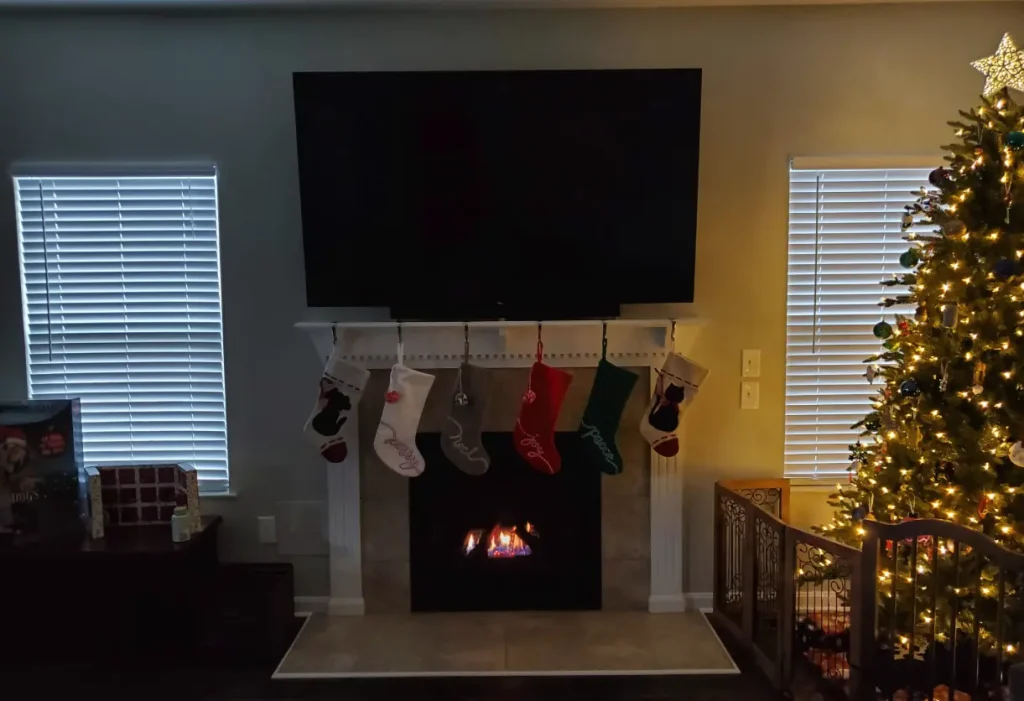
Image: itsnotatoomer on Reddit
Yes, you can mount a TV above a gas fireplace. But only if the manual, TV height, clearance, and heat protection all meet the manufacturer’s limits.
And the real risk isn’t a quick burst of heat. It’s the steady heat from your gas fireplace that builds up around the screen, bracket, and wall cavity.
Even if the wall feels “just warm” to your hand, it can still be too hot for your TV after one long evening with the fire on.
Yes, the problem is a temperature gap. TV manufacturers warn that internal parts should not go above 40°C, but gas fireplaces get much hotter.
- Surface Temperature — The metal top of an inbuilt gas log unit hits 200°C when running at full power.
- Ambient Air Temperature — The air one metre above the unit sits between 60°C and 80°C.
Standard wall mounts won’t protect your TV from rising heat. You need a physical barrier like a thick mantel, heat deflector, or recessed cavity, to push hot air away from the screen.
And your setup depends on how your fireplace vents.
Sealed, glass-fronted units keep most heat in the firebox and vent it through a flue, keeping the wall above cool. Open-fronted gas fires send a wave of heat straight up the wall.
Flueless models are riskiest. They dump all heat into the room, making them the most restrictive to install.
And there’s no one safe clearance that works for every fireplace. One gas fireplace might let you put a TV above it at a certain distance, but another could need a mantel, heat deflector, or an approved heat management kit.
What Heat Damage to a TV Actually Looks Like
You won’t see anything wrong for months, sometimes years. That’s what makes it dangerous. Heat slowly damages your electronics.
TV brands design their hardware to work only within a certain temperature range. Most set a maximum safe ambient operating temperature between 35°C and 40°C.
When rising heat from an unshielded gas fireplace flows over the screen, the temperature around the unit exceeds this limit. This causes steady hardware degradation.
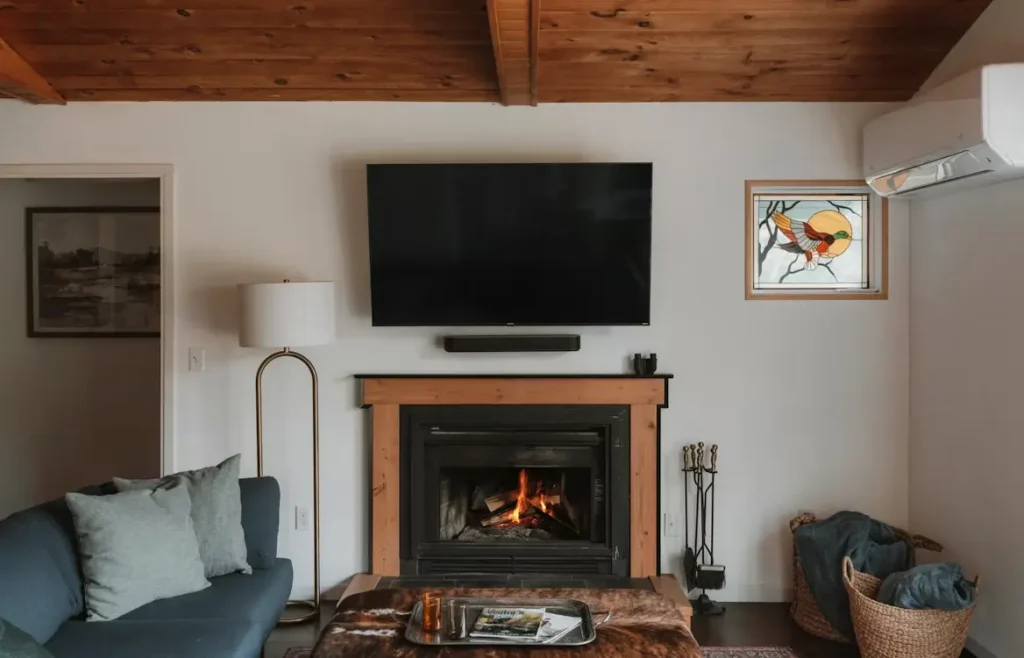
Image: Clay Banks on Unsplash
This constant heat damages your TV in three ways:
- Component Stress: Extreme heat damages the internal electronics. It dries out capacitors, warps circuit boards, and weakens solder joints until the TV won’t turn on.
- Panel Degradation: The LCD or OLED display panel is very sensitive to temperature changes. Too much heat causes screen discolouration, dark spots, permanent ghosting, or vertical lines on your picture.
- Chassis Warping: The plastic casing and bezel are not made for fireplace-level heat. Over time, the chassis will soften, sag, or separate from the screen glass.
If you mount a TV above a fireplace, don’t count on your warranty. Manufacturers won’t cover heat damage. If a technician opens it up and finds warped plastic or damaged circuits from the heat, your claim gets denied.
Minimum Clearance: How Far Above the Fireplace Should the TV Sit?
You need to check your gas fireplace manual for clearance distances. Manufacturers figure these out by testing in a lab.
AS/NZS 5601 sets the rules for flue terminal clearances outside, but the manufacturer decides the internal TV clearance. If you ignore the spec sheet, your installation won’t be compliant.
For example, some modern sealed units like the MODE KB1400 only need 200mm clearance. Others need much more. That’s why you must check your specific model.
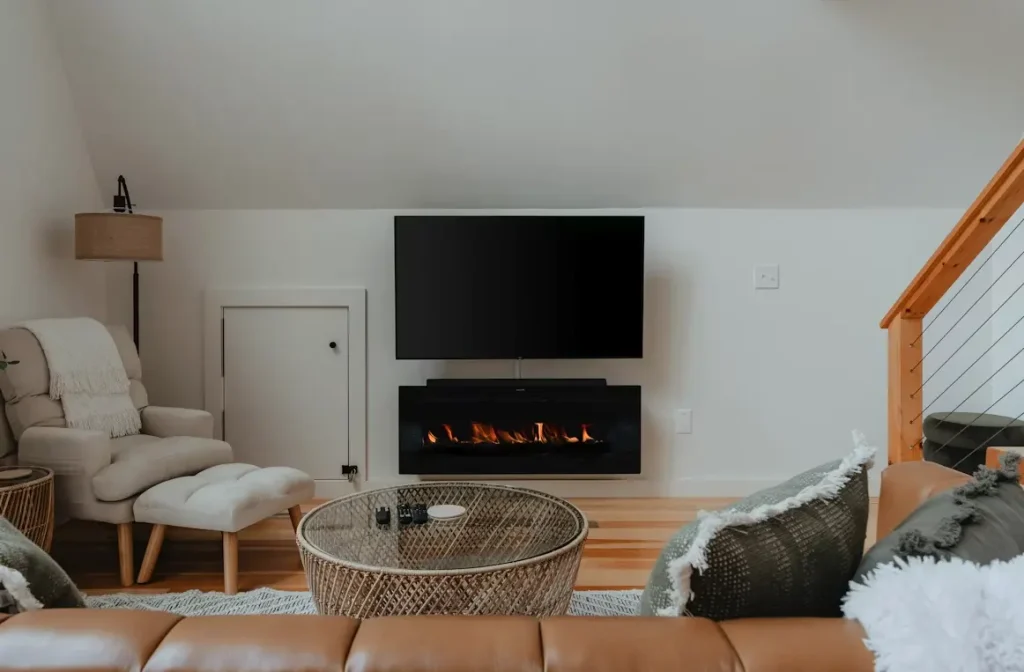
Image: Clay Banks on Unsplash
| Gas Fireplace Type | Required Minimum TV Clearance Metric |
|---|---|
| Modern Sealed Linear Units | 200–300mm minimum starting range for engineered models. |
| Standard Glass-Fronted Units | 350mm average clearance from appliance top to underside of the TV bezel. |
| Dedicated Low-Clearance Units | Specialised internal heat-ducting allows tighter zones. |
| Older Open-Fronted Units | 600mm+ clearance; requires secondary passive heat deflection. |
| Flueless Gas Fireplaces | Maximum clearance required. Strictly bound to the model plate. |
Find the manufacturer’s metal compliance data plate to see the exact rules. Check inside the bottom control louver or valve access panel.
If you can’t find this plate and don’t have the manual – which is common in older Northern Beaches homes with 1990s units – then stop.
Guessing by looks ruins electronics. And you need to hire a licensed gas fitter to identify the unit and get the original engineering schematics.
When in doubt, oversize the clearance. It’s the only way to isolate the TV from rising heat.
If the screen ends up too high, get a dynamic mantel mount that pulls down and tilts forward, protecting the hardware without straining your neck.
How to Protect Your TV from Heat Damage
Clearance is important. But most Sydney living rooms still need one of these three heat management methods:
1. Mantels and Shelves
A mantel or shelf between the firebox and TV works as a solid deflector. Rising warm air hits the underside hard. It pushes forward into the room instead of racing up the wall straight at the screen.
You can’t just nail trim to the wall. Your mantel needs to stick out at least 100–150mm to deflect heat. Any less, and hot air flows into your TV’s bottom vents.
And material choice matters. Stone and concrete stay non-combustible. They’re the easiest choice. Timber is common, but it burns. So it needs a minimum gap from the firebox, as set out in AS/NZS 5601.1:2022.
2. Heat Deflector Shields
Mount a heat deflector above the firebox. It pushes rising heat sideways or outward at an angle. This protects the firebox top and plasterboard wall from constant cooking.
Choose a deflector when you don’t have room for a deep mantle. And install custom metal profiles to protect your electronics without eating up living room space. They cut the heat column in half.
Also, treat installation onto a gas fireplace chassis as regulated work. If you bolt aftermarket metal and puncture the sealed combustion chamber, you vent carbon monoxide straight into your home.
3. Recessed or Built-In Alcoves
Recess your TV into the wall. That creates a deeper buffer between the heat source and the screen. You get the cleanest look with flush surfaces, hidden cables, and zero exposed bracket hardware.
Plan the timing from day one. Design the TV recess above a gas fireplace when you install the fireplace or do a full living room renovation.
Then, add cavity ventilation with at least a 2,000mm² opening at each end of the wall cavity to stop heat building up inside the wall.
Retrofitting a recess into a finished wall works, but it costs a fortune. Only use this for new builds and full renovations, not a simple TV upgrade.
Can You Retrofit a TV Above an Existing Gas Fireplace?
Yes. This is the most common setup: a gas fireplace with a wall above it. In most cases, you can do it without touching the fireplace.
So, start with the model plate on the unit. Look up the manufacturer’s installation manual. Most Australian brands have PDFs online.
Then, find the minimum clearance from the top of the appliance to the bottom of your TV, then measure the actual gap.
If the clearance matches the spec, or you can fix it with a mantel or deflector, your heat problem is solved. But, if you can’t read the model plate, stop. Call a licensed gas fitter to ID the unit and approve the clearance.
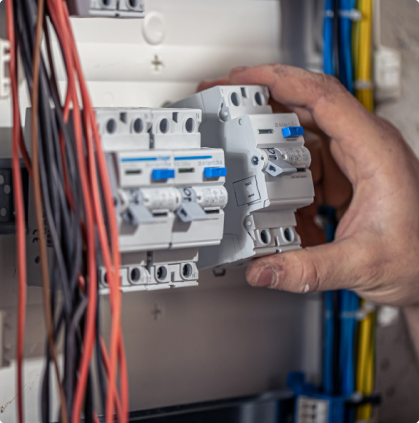
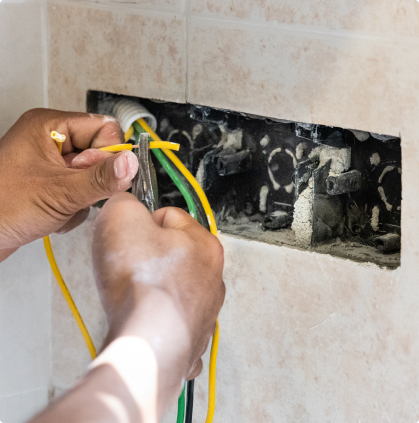
Also, cable routing and power are a separate trade. Don’t cut a recessed power outlet above a gas firebox. Hire a licensed electrician. Remember, running unprotected cables through the rising heat column is a direct fire risk.
Other Factors to Get Right
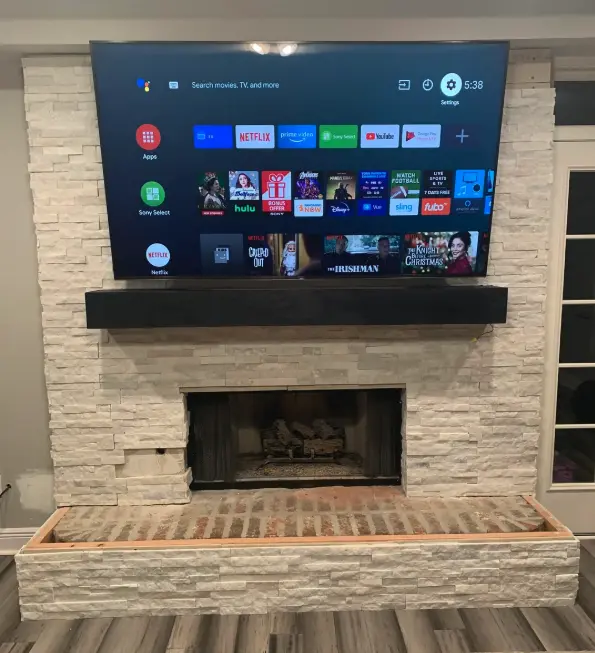
Image: blockburner28 on Reddit
Once heat safety is settled, a few practical details separate a working install from a truly comfortable one:
1. Viewing Height
On a normal couch, your eyes are about 1,050–1,100mm off the floor. Mounting a TV center above a gas fireplace puts the screen at 1,600–2,000mm high. That’s 500–900mm above where your eyes actually are.
Use a tilting mount to point the screen down toward the couch. Even better, grab a pull-down mount. It drops the TV to eye level when you watch, then tucks flat when you’re done.
2. TV Proportionality
Match your TV to the fireplace, not your ego. Make sure the fireplace is at least as wide as the TV so it looks balanced.A 75-inch screen above a small gas insert doesn’t work.
So, make sure you measure the fireplace width first, and then choose a TV that fits. Keep it proportional.
3. Cable Management
Route every cable before you mount anything. In-wall power and HDMI channels give you the cleanest look.
But that’s electrical work. So, hire a licensed electrician and work with your heat shield install so cables stay away from the hot air above the firebox.
And if you use surface-mounted cable covers, run them to the side walls, away from the heat zone.
When to Call a Professional
A homeowner can check specs against a manual, mount a standard TV bracket into masonry or timber studs, and run external cable tracks. That’s what you can do yourself.
For anything else, you cross a legal trade boundary. Use this guide to know when to put down the tools and call:
- When the fireplace is unlabelled or older — If the unit’s model plate is missing or unreadable, don’t guess the numbers. Never assume modern clearance rules apply to an older model that may radiate higher temperatures. Stop and call a specialist.
- When you touch the gas, flue, or firebox layout — Under the Gas & Electricity (Consumer Safety) Act 2017, you need a licensed gasfitter to change a flue, firebox, or gas line. AS/NZS 5601.1:2022 says you must submit the work through the BCNSW eCert portal within five business days. If you don’t have a compliance certificate, the installation is illegal.
- When cabling or power goes inside the wall — In NSW, you need a licensed electrician to fish HDMI cords, run mains power through walls, or install recessed outlets behind your TV. Running standard PVC lines through a live combustion heat column is a serious fire risk. A pro has to install thermal-rated cabling and keep legal isolation distances.
If your Sydney home hits any of these triggers, don’t risk your property or policy. Lightning Bult’s gas fireplace specialists can identify your model, confirm safe clearances, and execute licensed modifications.
FAQ about TV Above a Gas Fireplace
Here are the questions Sydney homeowners ask most when planning a TV above their gas fireplace.
How close can a TV be to a gas fireplace?
For modern sealed gas fireplaces, keep the TV 200–300mm from the top. Older open-fronted units need 600mm or more, plus a heat deflector. Always check the manufacturer’s manual.
Does a gas fireplace damage a TV faster than an electric one?
Yes, generally. Gas fireplaces push heat upward, while electric ones blow it forward. Without enough clearance, temperatures can exceed 40°C, which is above the 35°C max most brands allow.
Do I need a licensed gas fitter to mount a TV above my fireplace?
For mounting the bracket, no. But changing the flue, firebox, gas connection, or adding a heat deflector requires a licensed gasfitter under NSW law. Unsure about clearance? Get a professional to check first.
Can I put a TV above a freestanding gas fireplace?
In most rooms, it’s not practical. Freestanding gas fireplaces have an exposed flue that takes up TV space. Mount the TV on a nearby wall instead. Placing it behind or above the flue isn’t safe without custom non-combustible engineering.
What is the best way to hide cables for a TV above a gas fireplace?
To keep cables away from heat, ask an electrician to install in-wall channels with a recessed power point. However, surface-mounted covers along the side wall are cheaper. And never run cables through the heat column. It’s a fire risk.
Conclusion
Done properly, a TV above a gas fireplace is a safe, well-established layout. What you need is proper clearance, heat management, and a professional check.
Lightning Bult’s team can check your setup, confirm safe clearance for your model, recommend the right heat protection, and handle any gas fitting work. Get in touch for a quote across Sydney.