






Choosing a gas fireplace is an exciting milestone in any home renovation. It has the power to completely transform the atmosphere of a room, bringing warmth and a striking design feature together in one package. But before you get caught up in picking specific styles or brands, the top priority is about the gas fireplace sizes.
Getting the dimensions wrong can throw off everything from the room’s visual balance to its actual physical comfort. A unit that is too small will look underwhelming and lost on a large wall, while one that is too large can completely overpower the space or turn your living room into a sauna.
If you are trying to make sense of standard gas fireplace sizes, this guide will walk you through the common dimensions and help you pinpoint the exact fit for your home.
Why Size Matters and the Standard Dimensions to Know
The right gas fireplace dimensions impact how efficiently the unit heats the room, installation costs, venting requirements, and the overall architectural balance of the space.
A well-chosen fireplace should feel like it was built specifically for the room, not squeezed in as an afterthought. Gas fireplaces generally fall into three standard categories:
- Small Gas Fireplaces (600mm–900mm wide). Ideal for apartments, bedrooms, or compact alfresco areas, these units typically measure 500mm to 700mm high and 300mm to 400mm deep.
- Medium Gas Fireplaces (900mm–1400mm wide). This is the sweet spot for the vast majority of homes. Standing 600mm to 800mm high and 350mm to 500mm deep, medium units beautifully anchor standard living rooms, open-plan family areas, and dining spaces.
- Large Gas Fireplaces (1400mm–2400mm+ wide).If you are looking for a show-stopping statement piece, this is your category. Designed for luxury builds, expansive open-plan homes, and dramatic feature walls, these sprawling units create an incredible focal point—provided you have enough wall space to let them breathe.
Finding the Perfect Fit Between Matching Scale, Layout, and Heat Output
Choosing the right size is a delicate balancing act between visual scale and actual heating demand. As a rough guide for scale, rooms under 20m² generally suit a 600mm–900mm width; spaces between 20–35m² handle 900mm–1400mm beautifully; and anything over 35m² can easily accommodate a 1400mm+ model.
But your layout matters just as much as your floor space. If you have soaring high ceilings, a taller, more traditional fireplace can help draw the eye upward. Conversely, long, unbroken feature walls practically beg for a wide, modern linear model.
Crucially, you must also factor in heat output. A larger unit usually packs a higher kilowatt (kW) output, and while that sounds cozy, pumping 8kW of heat into a tiny enclosed snug will make the room uncomfortably hot and terribly inefficient to run.
As a general guide, small rooms only need about 2kW–4kW, medium rooms require 4kW–7kW, and large open spaces need 7kW or more.
How Style and Installation Type Change Your Actual Footprint
It is easy to look at a brochure and assume a 1000mm fireplace only takes up 1000mm of space.
In reality, whether you choose a built-in or freestanding model dramatically changes the actual footprint. Built-in fireplaces require extra cavity space, mandatory ventilation clearances, and framing.
Even freestanding units need specific wall and hearth clearances for safety. You always need to account for installation clearance, gas connection points, flue placement, and non-combustible materials.
The visual style you choose also manipulates how large the fireplace feels:
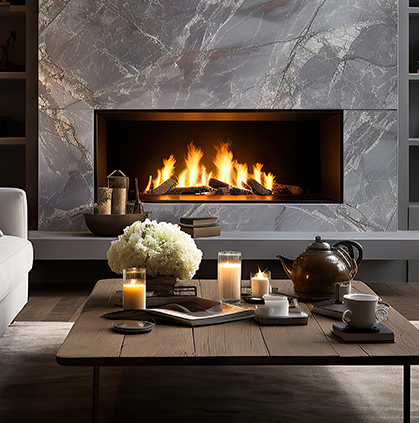
- Linear Fireplaces. Long, sleek, and modern. They eat up horizontal width but save on height, making them perfect for contemporary homes.
- Traditional Fireplaces. Boxier and taller, requiring less width but commanding more vertical presence in classic spaces.
- Double-Sided & Corner Fireplaces. Double-sided units act as brilliant room dividers but require massive overall volume, while corner models are ingenious space-savers for awkward layouts where flat wall space is limited.
Frequently Asked Questions
What is the most common gas fireplace size?
For the average home, a width between 900mm and 1400mm is the undisputed sweet spot. It perfectly anchors a standard living room without overwhelming the space.
Can a gas fireplace actually be too big for a room?
Absolutely. If the heat output is too high for the square footage, you will be constantly turning it off because the room will feel like an oven, wasting both energy and money.
Are bigger gas fireplaces always more expensive?
Generally, yes. Not only does the unit itself cost more, but the framing, larger flue requirements, and increased installation labor all add up quickly.
Can I replace my old fireplace with a much bigger one?
It is possible, but it depends heavily on your existing wall structure, flue access, and whether your current gas line has the capacity to feed a larger, more demanding unit.
Need Help Choosing the Right Gas Fireplace Size?
Picking the right fireplace needs to suit your room, your heating needs, and the overall feel of your home.
A good rule is to think about both visual scale and heating demand. Here is a rough guide:
| Room Size | Suggested Fireplace Width |
| Under 20m² | 600mm–900mm |
| 20–35m² | 900mm–1400mm |
| 35m²+ | 1400mm+ |
At Lightning Bult, we help homeowners choose and install the right gas fireplace for their space — whether it is a compact living room feature or a full statement wall. Our team is ready to assist you with anything related to gas fireplace across Sydney, including local suburbs such as Davidson, Ingleside, and Killarney Heights.
Not sure what size will work best? Get in touch with our team today and we’ll help you find the perfect fit for your home.