










Don’t make that mistake. BTU shows how much heat an appliance can produce or remove. Knowing about BTU helps you compare options and talk confidently with air conditioning services. Let’s dive in.
What is BTU and What Does It Stand For?
BTU stands for British Thermal Unit. It is a metric used in HVAC systems to measure thermal energy capacity, like in air conditioners and other heating units.
In an AC system, a BTU shows how much heat an air conditioner removes from the indoor air in an hour. So, the BTU rating indicates your system’s capacity. An 8,000 BTU unit removes 8,000 BTUs of heat every hour.
Basically, the higher the BTU rating, the more heat the unit can remove. It shows how many square metres it can cool effectively. That’s why choosing the right AC size matters for staying comfortable.

Keep in mind that BTU has been a standard measurement in the United States since the 20th century. But, in countries like Australia, manufacturers typically use kilowatts (kW) to indicate cooling capacity.
Even so, technical documentation still cites BTU output ratings because gas energy content is standardised internationally in BTU.
The conversion between these units is simple: 3,412 BTU equals 1 kW. So, a 12,000 BTU unit is about 3.5 kW.
In Australia, retailers usually offer standard split systems sizes, with a 2.5 kW (approx. 8,500 BTU) unit suitable for bedrooms or small spaces up to 20 square metres.
In contrast, whole-home ducted systems usually have bigger capacities, from about 5.0 kW up to 24 kW (around 17,000 to 82,000 BTU), to fit different home sizes.
Why Does BTU Rating Matter?
These are some of the reasons why the BTU rating is important.
1. Standardised Metric
BTU measures cooling power consistently. A 12,000 BTU unit cools the same regardless of brand. In Australia, you convert BTUs to kilowatts (kW) to compare capacities.
This standard makes sizing straightforward, saving time and reducing confusion. No more guesswork.
2. Understand Options Better
Without a capacity rating like BTU or kW, choosing an air conditioner can be challenging. Salespeople may say, “This one should work,” but without specifications, you can’t be sure.
A BTU rating also guides your choice based on experience. If your 3.5 kW (about 12,000 BTU) unit cools effectively, you can stick to a similar size when adding another.
3. Consistent Comfort
The capacity rating helps you choose the right AC size. An undersized unit runs constantly but doesn’t cool enough, while an oversized one cools too fast and shuts off before reaching the set temperature.
The ideal size reaches temperature quickly and maintains it steadily without frequent cycling and issues like AC not blowing cold air.
4. No High Bill Surprise
Without knowing your space’s cooling needs, you risk choosing the wrong size equipment, which drives energy bills significantly higher than expected. This is why knowing about BTU means a lot.
An undersized unit runs nonstop at full power, wasting energy and never reaching comfort. An oversized system short-cycles, using energy on frequent startups and never running efficiently.
You want to avoid both of those because that’s just how the AC system works.
5. Better Unit Lifespan
You don’t want your AC to quit in five to seven years when it should last 15-20 years. But if the capacity is too low, it’ll run constantly. This puts extra stress on parts, making them wear out faster.
An oversized unit cools the room too fast and then turns off. This rapid cycling strains the compressor and shortens its lifespan.
6. Healthier Home
A properly sized AC unit cools and dehumidifies in steady cycles. The coil cools, removes moisture, and drains it, preventing dampness. But, an oversized unit cools too fast, shuts off early, and leaves the air clammy.
With the right BTU rating, you can make sure your AC controls both temperature and humidity, creating a comfortable, healthy indoor space.
7. Warranty Coverage
Manufacturers make AC units for specific room sizes. The capacity rating shows what size room the unit is meant for. Using a small unit for a big room or vice versa goes against the instructions.
And if any AC unit parts break and you ask for a warranty, the company can say you didn’t use the unit correctly.
How to Calculate BTU You Need in Your Property
Here’s how to figure out the BTU you need if you’re installing or upgrading your AC for better cooling.
1. Rule of Thumb Calculation
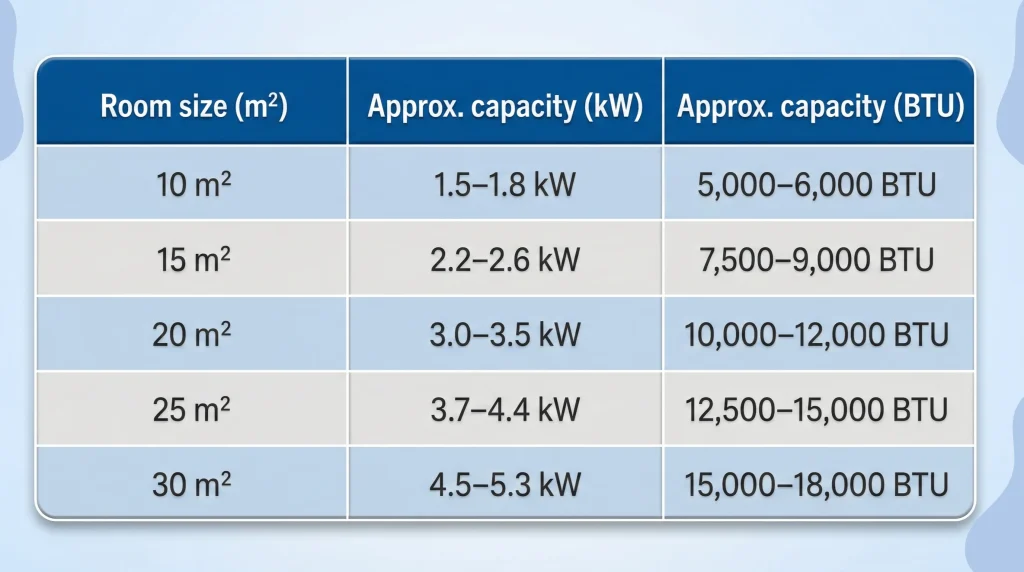
This method helps you estimate your cooling needs based on its floor size. It’s not a substitute for a professional calculation, but it offers a clear starting point.
You’ll know if you need around 8,000 BTU or 12,000 BTU, instead of guessing. It works best for typical Australian rooms with standard ceiling heights and average insulation, like bedrooms and small living areas.
How to use this method
- Measure the room’s length and width in metres.
- Multiply to get the floor area in m².
- Use 0.15–0.18 kW per m² as a starting point.
- Multiply area by 0.15 and 0.18 for kW range.
- Convert to BTU by multiplying kW by 3,412.
- Choose a standard size like 2.0, 2.5, or 3.5 kW.
2. Online Calculator
You can use an online calculator with your home’s details to get a more accurate estimate of the capacity (kW or BTU) you need.
And instead of just checking the floor size, it asks about ceiling height, insulation, windows, and how you use the room. It’s perfect if you want a better answer than a basic rule of thumb but aren’t ready to hire a pro yet.
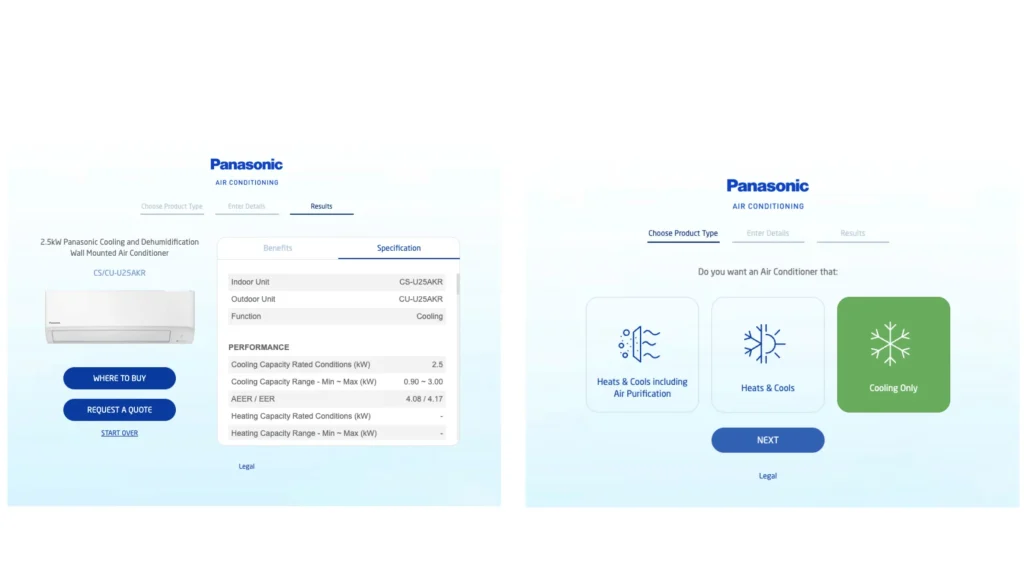
How to calculate the capacity for your cooling system using an online calculator?
- Find a good online calculator from a trusted retailer, or brands like Panasonic Australia.
- Launch the Wizard and choose the Cooling Only option.
- Choose your insulation type, facing windows, and room area.
- You’ll get the products to use and technical specifications mentioning the kWh or BTU.
3. Professional Load Calculation
If you want a detailed heat-load calculation, it’s best to hire an HVAC pro. They’ll do a full assessment (often called a Manual J calculation).
They’ll look at the whole building, climate, and how you use your home. It’s helpful for ducted systems, big open spaces, complex houses, or if you want something reliable long-term.
What should you do with this calculation approach?
- Ask your trusted HVAC technician if they perform a load calculation
- Allow them to measure room dimensions, ceiling heights, construction, insulation, and floor types.
- Have them record window sizes, glazing, orientation, and shading.
- Provide information on occupancy, appliances, internal heat sources, and usage.
- Request a summary of results and the final unit size, including safety margins.
FAQ about British Thermal Units
Let’s review the most common questions homeowners have about BTU meaning:
Does higher BTU mean more heat?
A higher BTU rating shows a unit can move more heat energy each hour. In cooling, this means it removes more heat from indoor air, providing better cooling. In heating, it delivers more heat into the space per hour. But, BTU itself measures heat transfer, not how hot a room feels.
What is a good BTU for a room?
It depends on size and conditions. For Australian bedrooms of 10–15 m², 2.0–2.5 kW (7,000–8,500 BTU) works. Larger living rooms of 20–40 m² need 3.5–5.0 kW (12,000–17,000 BTU).
But remember that rooms facing north or west with large windows need more cooling due to solar heat. And for ceilings around 3 metres, increase capacity by 20–25% for the extra air volume.
What happens if BTU is too low?
If the BTU is too low, the AC acts like an undersized unit. A 20 m² bedroom needs about 7,000 to 9,000 BTU (2–2.6 kW). Many use only 5,000 BTU, which runs nonstop, struggles on 30–35°C days, and never dries the air.
This also means higher energy bills, as the system works at full capacity all the time. And constant use speeds up wear and tear. An undersized system may fail in 5 to 10 years, instead of lasting 15 to 20.
Conclusion
BTU isn’t just a random number on a sticker. It’s your cheat sheet for picking heating and cooling that works for your home. Once you get it, you’ll see which units will struggle, short-cycle, or fail early.
And if you’re still unsure, even after doing your research, just reach out to Lightning Bult. We can help you figure out the right size for your system so you don’t have to do all the maths.