


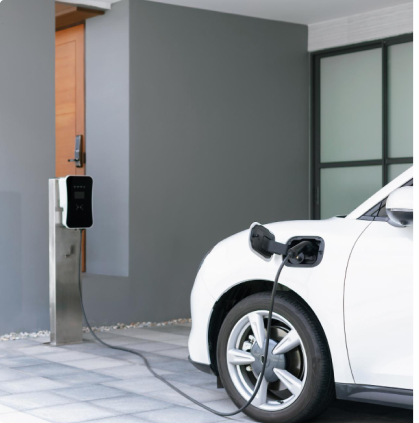

A Level 2 EV charger is a dedicated home unit offering faster AC charging than a standard outlet. But the term can be confusing, as “Level 2” can also refer to an Accredited Service Provider handling grid connections.
This guide explains charging levels, single-phase and three-phase capacity, and how an EV charger installation Sydney assessment determines what your car and home can support.
What Does “Level 2” Actually Mean for an EV Charger?
First, it’s important to clarify what ‘Level 2’ means. Charging levels talk about the approximate power and type delivered to an EV, not an electrician’s licence or accreditation.
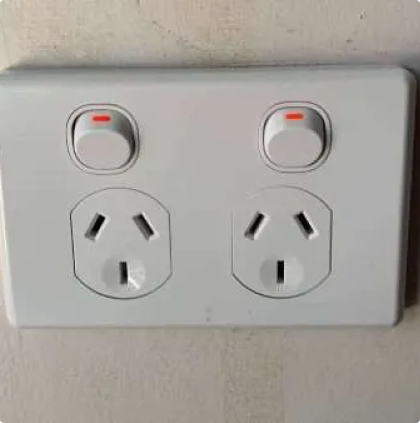
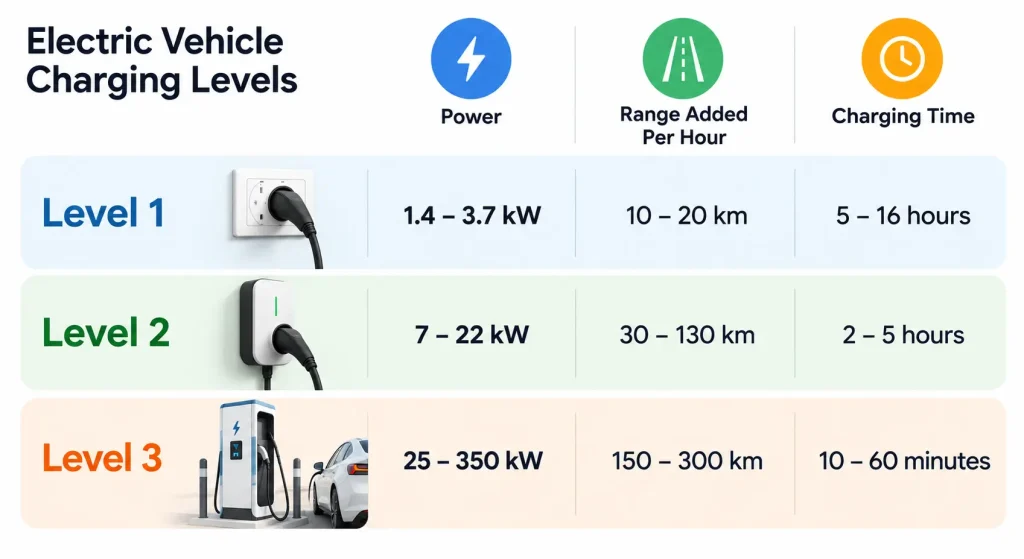
- Level 1 uses a compatible portable charging cable plugged into a standard household power point. It’s slower AC charging, with a maximum output of about 2.4kW.
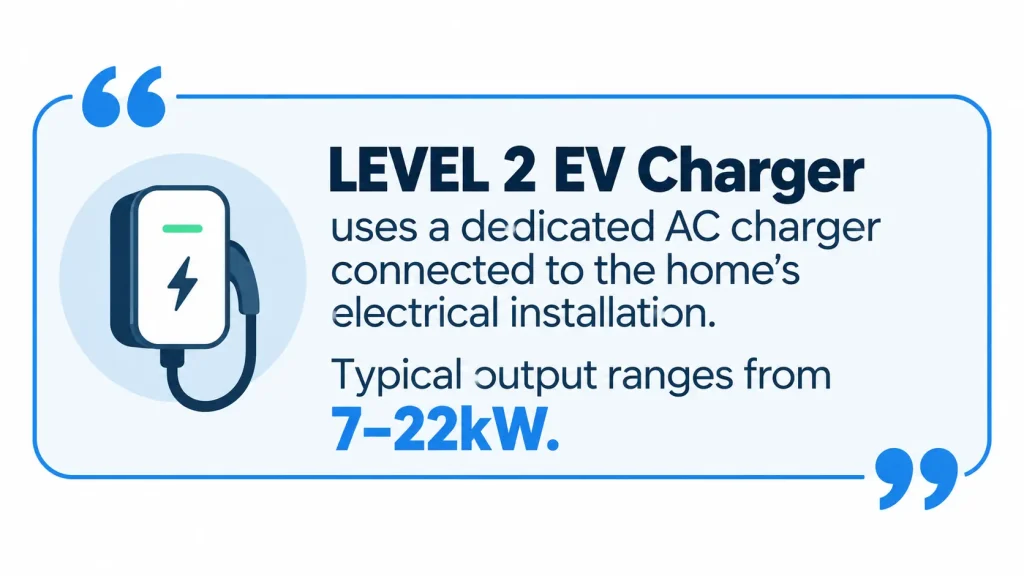
- Level 2 uses a dedicated AC charger connected to the home’s electrical installation. Typical output ranges from 7–22kW.
- Level 3 provides high-power DC charging. These rapid chargers are mainly found at public charging sites and along highways.
For home charging, Level 2 is the standard dedicated option. Some units also support scheduled or solar-aware charging.
The Evnex E2 is an example. The manufacturer sets the E2 range up to 7.4kW on single-phase power. Lightning Bult’s Evnex E2 charger review looks more closely at this home charger type.
The charger’s number isn’t everything. Your car limits AC power intake. So, if its onboard charger maxes out at 7kW or 11kW, it won’t draw 22kW from a 22kW wall charger.
Level 1 vs Level 2 vs Level 3: At a Glance
The times below show charging a 60kWh battery from empty. In practice, it might take longer due to conversion losses, battery temperature, charge management, and the vehicle’s power limit.
| Charging level | Typical power output | Approximate charging time | Suitable at home? |
|---|---|---|---|
| Level 1 AC | Up to 2.4kW | Around 25 hours or more | Yes, where the power point and charging setup are suitable |
| Level 2 AC | 7–22kW | Roughly 3–9 hours | Yes |
| Level 3 DC | Commonly 25kW and 350kW | Around 10-60 minutes | Rarely |
Level 3 might look like the clear choice, but charging speed isn’t the only factor. Its power and infrastructure needs fit public charging spots better than a regular Sydney garage.
Do You Actually Need a Level 2 Charger, or Will Level 1 Do?
Level 2 is recommended, but not every driver needs it. The main question is: can your car recharge the energy it uses daily while parked at home?
A Level 1 portable charger draws 10A from a standard power point and adds 10–12 km of range per hour. It works for drivers with commutes under 40 km, 12 hours of overnight parking, or plug-in hybrids with 10–14 kWh batteries.
For primary EVs used daily, manufacturers and installers suggest Level 2. At 7kW, it adds 40–45 km of range per hour. That’s ideal for longer commutes and irregular schedules, especially in homes with multiple EVs.
It also fits short off-peak slots, such as midnight to 6:00am, which might not work for Level 1 trickle charging.
If Level 1 leaves you short on charge or sends you to public stations, treat it as an emergency or travel option instead.
And keep in mind that a dedicated Level 2 unit can schedule off-peak charging and divert surplus rooftop solar.
Single-Phase vs Three-Phase: What This Means for Sydney Homes
Most Sydney homes have single-phase power, which limits a Level 2 charger to 32A (about 7.4kW). That can recharge a 60kWh battery from empty in roughly eight hours.
Three-phase power supports 11kW or 22kW charging. You’ll find it in newer estates, commercial sites, and some Inner West developments.
But, remember, your car still determines your charging speed. Many popular Australian EVs, like the Tesla Model Y, have 11kW onboard AC limits. Even on a 22kW charger, they’ll only draw 11kW.
You can check the meter box glass for a quick look at the supply type.
A single-phase setup usually has one main switch, while three-phase generally has three linked ones. That’s just a clue, though. Always confirm your supply type with a licensed electrician before buying equipment.
Older Sydney Homes and Switchboard Capacity
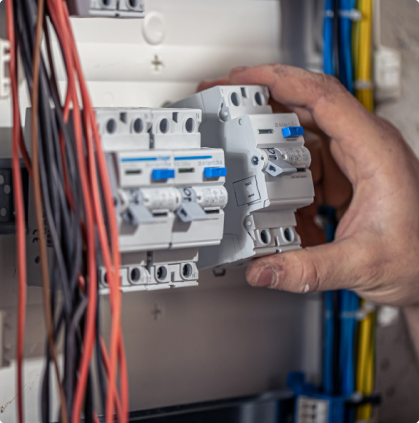
Many pre-2000 terraces, semis and fibro homes across the Northern Beaches, North Shore and Inner West still use rewirable ceramic fuses.
Under AS/NZS 3000 wiring rules, an EV charger is considered a continuous heavy load. So, it needs a dedicated circuit with modern circuit breakers and appropriate RCD protection. That includes a Type A RCD where the charger’s design and fault-current protection allow it.
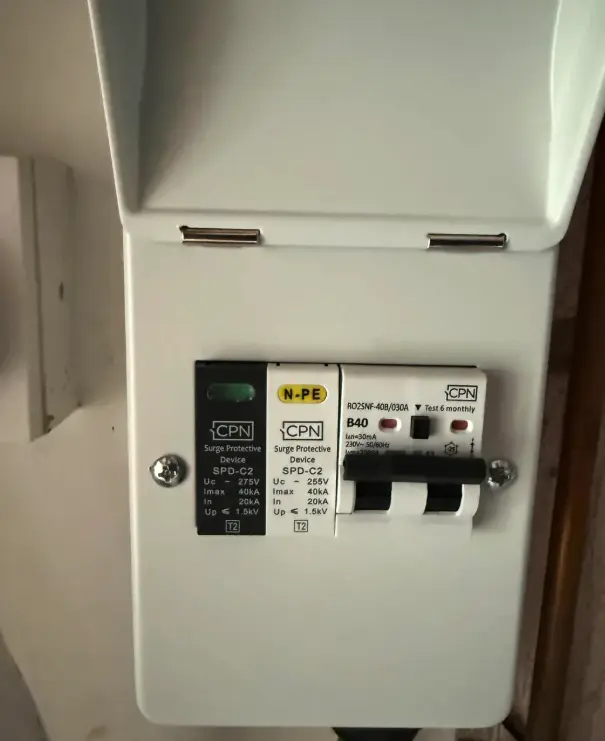
Image: EcstaticShoehorn5588 on Reddit
Your switchboard also needs enough physical room. If it’s cramped, or if adding a 32A load pushes your maximum demand too high alongside AC and induction cooking, you’ll need an upgrade.
The actual requirement depends on the existing installation, available capacity and the installation instructions.
Please note, don’t open a live switchboard yourself. Our electrical services can assess the switchboard’s capacity, calculate maximum demand and check cable routes before you buy the hardware.
Installation and Compliance Requirements in NSW
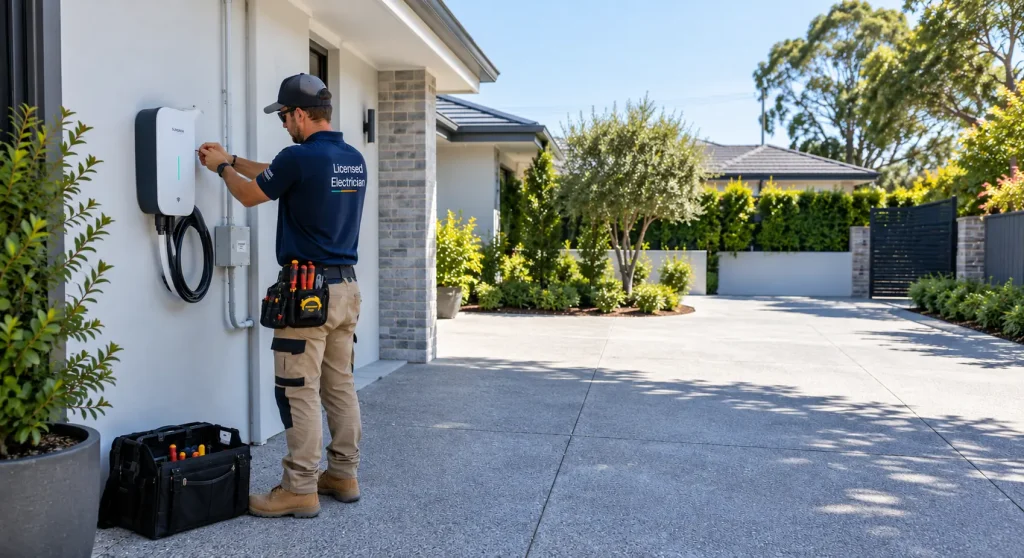
You can’t install a Level 2 charger yourself. You’ll need a professional to set it up, test it, and make sure it’s safe.
The electrician will check:
- if you need a separate circuit
- the right safety gear (RCD, RCBO)
- how the wires run and if the voltage is okay
- if your electrical panel and power supply can handle it
- how to manage power use when you need a lot at once
- how it’s mounted and if it’s protected from damage and weather
- the car and charger maker’s rules.
Remember, the safety features have to match the charger, not just a general safety upgrade. Lightning Bult’s RCD and safety switch installation guide explains how this protection works in your home system.
After testing, the electrician gives you a Certificate of Compliance for Electrical Work (CCEW). In NSW, it’s lodged through the Building Commission NSW eCert portal. Keep your copy, as it proves the installation was certified.
You don’t always need a permit for a Level 2 charger. Your electrician will tell you if you need approval, especially if your power supply needs an upgrade.
And that brings up another meaning of “Level 2.” A Level 2 ASP handles service lines, connection equipment, and changes to the network.
So, installing a level 2 EV charger at home doesn’t always mean you need an ASP2. But you might if the job involves work on your property’s network connection.
What a Level 2 Home Charger Actually Costs
The charger itself is only part of the cost. Cable route, parking layout, switchboard capacity, load management and any required supply upgrades all affect the final figure.
A basic 7kW unit installed near an accessible switchboard is quite straightforward. A 22kW smart charger that requires a three-phase upgrade is a different job, with more electrical work involved.
You can’t rely on online estimates. An on-site assessment is the way to price the complete installation, not just compare the charger’s retail price.
Ready To Find Out What Your Home Can Support For EV Charging?
A Level 2 EV charger speeds up home charging and adds convenience compared to a standard power point. But it’s not the right fit for every Sydney home.
Your car’s charging limit, daily driving and existing electrical supply all affect the best choice.
If you are weighing up your options, a professional assessment can give you a clear answer. Contact Lightning Bult to arrange a free assessment before choosing a charger. We support homeowners across Sydney, including local suburbs like Allambie Heights, Bilgola Plateau, Church Point, Cromer, and many more.
FAQ About Level 2 EV Chargers
Here are the questions Sydney homeowners ask most about Level 2 chargers:
Is a Level 2 Charger the Same as a Fast Charger?
Not in the typical public-charging sense. Level 2 is faster than charging from a household power point, but it still delivers AC power through the vehicle’s onboard charger.
“Fast” charging usually means Level 3 equipment that sends DC power straight to the battery at a public charging station.
Can I Install a Level 2 Charger Myself?
No. A fixed Level 2 charger needs electrical wiring and should be installed by a licensed electrician in NSW. The finished work also needs testing and documenting per applicable NSW electrical requirements.
Do I Need Three-Phase Power for a Level 2 Charger?
No. A single-phase charger supplying about 7–7.4 kW is a normal Level 2 home setup.
Three-phase power is relevant when you want 11 kW or 22 kW AC charging and both the property and vehicle can support it. It’s not a must-have for home charging.
Is There a Rebate for a Level 2 EV Charger in NSW?
There’s government support, but no universal cash rebate. Homeowners can access a $15k zero-interest Home Energy Saver loan for Level 2 EV chargers, subject to income, residency, property, and finance-provider criteria. Check the NSW home-charger assistance page before relying on support.
How Long Does a Level 2 Charger Take to Charge a Car?
A 7 kW charger needs about nine hours to deliver 60 kWh, not counting losses. At 11 kW, it’s around five and a half hours; at 22 kW, just under three hours.
These are delivery times, not car promises. Battery size, start charge, temperature, and AC limit affect real time.