




The right gas pool heater size comes down to three things: your pool’s volume, Sydney’s winter air temperature, and how many degrees warmer you want the water to be.
This gas pool heater size guide gives you a simple formula to figure out the MJ/kW output you need. You’ll be ready to ask your gas pool heater service provider the right questions and stay within your budget. Read on!
How Gas Pool Heaters Are Sized in Australia
Gas pool heaters warm water by burning gas. So, choosing the right size means getting enough heat without wasting energy. This is the most important part of your pool heating installation.
In Australia, each model lists two numbers: kW output and MJ/h input. kW shows how fast the heater can warm your pool water. MJ/h shows how much gas it uses per hour for heating.
Typical residential units use 100–400 MJ/h of energy, which creates about 25–100+ kW of heat output, or roughly 95,000–380,000 BTU/h for international models.
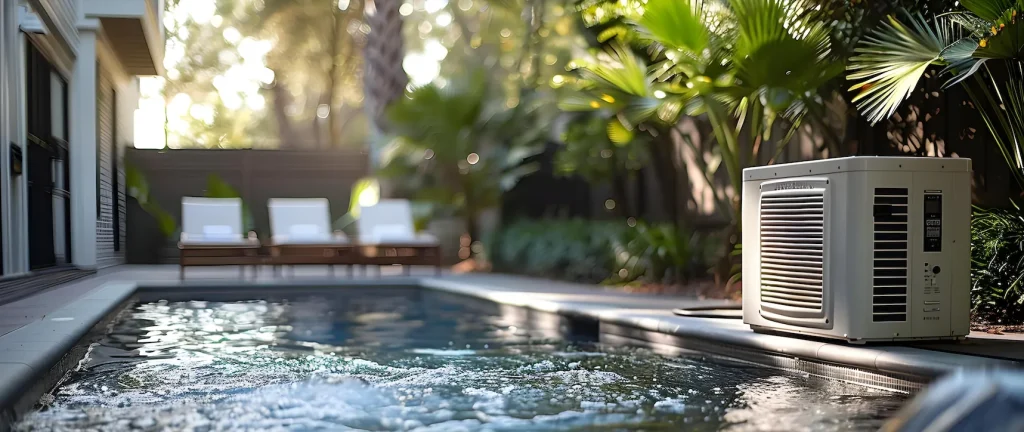
Image: naiklon1 on Freepik
Sizing comes down to one goal: the heater’s kW output must replace the pool’s constant heat loss and raise the water to your target temperature within a reasonable time.
Practically, 1 kW heats about 850–860 litres of water by 1°C per hour, not including wind or evaporation losses. But those losses are only one part of the factors.
Key Factors That Affect What Size Gas Heater You Need
Choosing the right heater size isn’t just about your pool’s size. Here are the main factors that affect your gas heater size:
1. Pool Volume
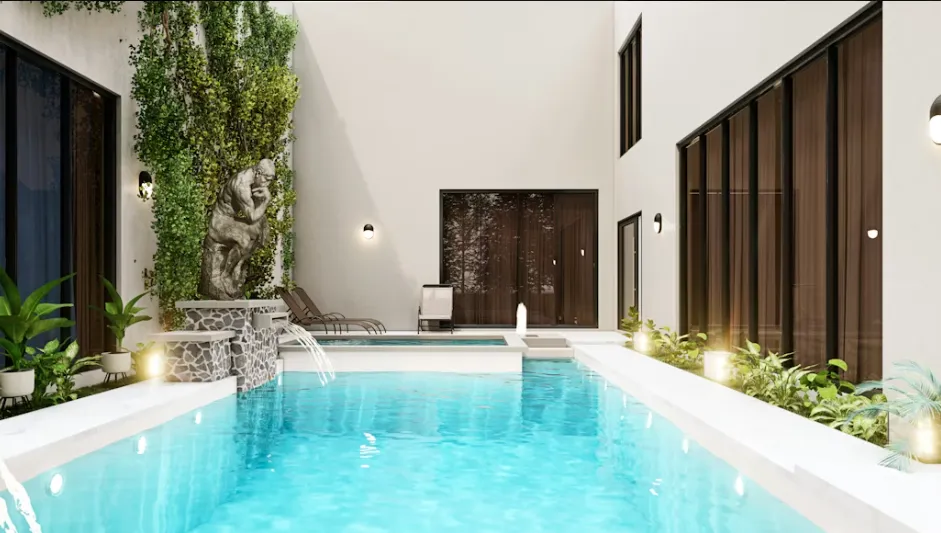
Image: Ferdinand Asakome on Unsplash
You need to know your pool’s total litres, because that’s the amount of water you’re heating. Basically, you can just multiply the length, width, and average depth by 1,000 to get your volume.
However, if you have a freeform pool, the standard method won’t work. You’ll need to adjust your calculation based on the specific shape of your pool.
2. Desired Water Temperature
For a casual swim, you need 24–26°C. For family fun, 28–30°C is ideal. For therapy, go for 30–32°C. So, how warm do you like your pool? That’s also an important factor for sizing.
Your goal temperature sets the “lift”. This is the difference between your pool’s current temperature and where you want it.
In Sydney, unheated pools drop to 14–16°C during spring and autumn. If you want 28°C, your heater must bridge a 12–14°C gap.
3. How Quickly You Want to Heat the Pool
Your pool size decides how much heat you need, but the heater’s power decides how fast you get it. This is one of the factors when comparing gas vs electric pool heater.
For a 50,000-litre pool, a 200MJ heater takes about 20 hours to raise the temperature by 12°C. If you switch to a 400MJ unit, you cut that time in half to 10 hours, which makes a big difference.
4. Sydney Climate and Wind Exposure
Your heater works differently in a sheltered Sydney courtyard than in a windy backyard. Sydney winds hit 12–19 km/h, and even a light breeze doubles heat loss through evaporation.
A 250 MJ heater might warm a 50,000-litre pool in a sheltered garden. In a windy spot, you would need a 350 MJ or 400 MJ heater.
5. Whether You Use a Pool Cover
A pool cover makes a big difference. About 70% of pool heat escapes from the surface, and a good cover can cut that loss by 50–75%. This is the factor that applies to other pool heating options as well.
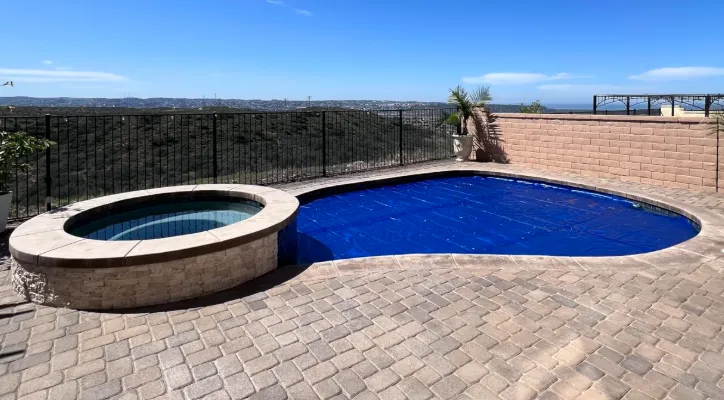
Image: Amazon
How to Calculate Your Gas Pool Heater Size
Before you call a licensed gasfitter, use this quick guide to estimate the minimum heater size you need. However, this doesn’t replace professional advice.
1. Calculate Your Pool Volume
Pool volume is the total litres your pool holds. Getting this right is vital. Then how to calculate your gas pool heater size?
Rectangular Pools
Most Sydney pools are rectangular. You can use this formula: Volume (litres) = Length (m) x Width (m) x Average Depth (m) x 1,000
So for example: an 8m x 4m pool with a 1.5m average depth contains 48,000 litres.
Circular Pools
If you have round plunge pools or circular above-ground setups, you can use this formula: Volume (litres) = 3.14 x Radius squared (m) x Average Depth (m) x 1,000
For example, a 4m diameter pool (2m radius) with a 1.2m average depth contains approximately 15,072 litres.
Average depth = (shallow end depth + deep end depth) ÷ 2. Example: A 4m diameter pool (2m radius) with a 1.2m constant depth. Volume = 3.14 × (2 × 2) × 1.2 × 1,000 = 15,072 litres.
Irregular Shapes
If your pool is a free-form shape, break it into smaller sections. Or, just measure the longest and widest points and use this formula: Volume (litres) = Longest (m) x Widest (m) x Average Depth (m) x 0.85 x 1,000
For example, a freeform pool that is 7m long, 3.5m wide, and 1.4m deep holds about 29,155 litres of water.
Notes:
- To find the average depth, just add the shallow and deep end depths together and divide by 2.
- You can use these same calculations if you want to know how to size a pool heat pump
2. Determine Your Temperature Rise
You can decide how much warmer you want your pool. Start by noting your starting water temperature. In Sydney, an unheated pool is typically in the high teens to low 20s in the shoulder seasons.
Simple calculation: target water temperature minus average starting temperature = required temperature rise. This tells you the temperature rise you need.
For example, to reach 28°C from 18°C, you need a 10°C rise. If you want a larger increase (over 15°C), you’ll need a much stronger heater, and your energy bills will be significantly higher.
3. Apply the Sizing Formula
You can plug those numbers into a sizing formula to get a heater size band.
Start with this rule of thumb from Australian pool heating guides: in moderate climates, you need about 50,000 BTU of heater capacity for every 10,000 liters of pool water.
That’s your starting point. And for a more exact estimate, use this formula:
BTU/h needed = Pool volume (L) × 1.7 × temperature rise (°C) / 24
For example, a 40,000 L pool raised by 10°C over 24 hours needs roughly 28,000 BTU/h for maintenance. Most residential heaters are sized higher (often 200,000+ BTU/h) for faster heat-up.
To convert units, divide BTU/h by 3,412 to get kW, then multiply kW by 4.5 to get MJ/h input.
Finally, choose the next standard heater size up (e.g., 200, 250, 300, or 400 MJ/h) from your calculated minimum.
4. Adjust for Your Conditions
Now, tweak that number to match how and where you actually use your pool. This is key to get the ideal pool temperature.
Size up one band if:
- You leave the pool uncovered most of the time
- It’s in a windy spot or gets cold at night
- You want to heat it up fast from cold water for weekend use
You may stay in the same band if:
- The pool is indoors or sheltered
- You always use a good thermal cover
- You’re okay with slow heat-up but steady maintenance heating
Gas Pool Heater Size Quick Reference for Common Pool Volumes
If you want to double-check your numbers, this table shows the right gas heater size for common Australian pool volumes:
| Approx. Pool Volume (L) | Suggested Gas Heater Input (MJ/h) | Approx. Output (kW) | Typical Use Case |
|---|---|---|---|
| 20,000–30,000 | 100–150 | 25–38 | Small residential pools, covered, mild use |
| 30,000–50,000 | 150–200 | 38–55 | Medium family pools, weekend heating |
| 50,000–70,000 | 200–300 | 55–80 | Larger pools, faster heat-up needed |
| 70,000+ | 300–400 | 80–100+ | Very large pools or pool+spa combos |
These match international BTU charts that link pool sizes to heater output. For larger in-ground pools, you’ll want 250,000–400,000 BTU.
If your pool is uncovered, exposed to the wind, choose the next size up. Contact a licensed gas pool heating specialist to get advice for your specific site.
What Happens If You Get the Size Wrong?
Before you choose a size, make sure you know what happens if your gas pool heater doesn’t match your pool.
Undersized Gas Heater
An undersized heater is the most common problem and the most frustrating. Here are some of them:
- Shortened swimming season — Units running near-continuously often miss target temperatures on cool nights. Pools stay 4–6°C below target, cutting the usable season by 2–4 months.
- Inflated running costs — Constant operation spikes gas consumption. For a 48,000 L pool, undersized units can raise annual costs by 40–80%, potentially exceeding $3,000 without a cover.
- Premature mechanical failure — Maximum output stresses components, causing failure in 3–5 seasons. Issues like sooting and heat-exchanger cracking force replacements costing $3,000–$6,000.
- Increased maintenance expenses — Incomplete combustion triggers frequent service calls ($150–$300 each). Undersized gas lines may cause permanent damage, requiring expensive resizing.
- System-wide strain — Overworked heaters risk safety issues like flame rollout. Additionally, extended runtimes accelerate wear on pumps and filters, raising overall maintenance bills.
Oversized Gas Heater
Oversizing feels safer, but it has its own downsides. Some of them are:
- Higher upfront costs — Upgrading to a 350–430 MJ unit adds $1,000–$2,500, plus potential plumbing or electrical work. This pushes installed prices to $3,000–$6,000. Oversizing adds 30–50% to your bill.
- Short-cycling damage — Rapid heating causes the unit to cycle on and off frequently, stressing ignition, valves, and heat exchangers. This reduces lifespan by 20–40% and increases repair frequency.
- Wasted energy and higher bills — Oversized heaters burn extra gas, wasting hundreds annually in Sydney’s shoulder seasons.
- Installation headaches — Larger units may need bypass valves, plumbing upgrades, or risk gas-meter limits. In some suburbs, this can require costly utility provider upgrades.
FAQ About Gas Pool Heater Size Guide
These are the questions Sydney pool owners ask most about gas pool heater sizing:
What does MJ mean on a gas pool heater?
MJ stands for Megajoule. It’s a unit used to measure gas usage per hour (MJ/h). It shows capacity, not actual heat output. 2–4 MJ/h heats around one square metre. Higher MJ means more warmth.
How long does a gas pool heater take to heat a pool?
In Sydney, a gas heater raises water temperature by roughly 1°C per hour. For a 50,000-litre pool, reaching 28°C from cold takes 10–15 hours. A 400MJ unit does it in 8–10 hours; a 200MJ unit takes nearly 20 hours.
Can I use my existing gas line for a larger pool heater?
Possibly not. Most home gas lines can’t handle pool heaters that may require 400,000 BTUs. Gas companies may upgrade meters (for a fee), but a licensed gasfitter must confirm your supply pipe is properly sized.
Is it better to oversize a gas pool heater?
Moderate oversizing is recommended for faster heating and better wind resistance. But excessive oversizing is counterproductive. It demands costly gas line upgrades, raises upfront costs, and can cause “short-cycling.”
How much does it cost to run a gas pool heater in Sydney?
A 200 MJ gas heater consumes 200 megajoules hourly. With NSW gas costing 3.5–5 cents per MJ, running costs are roughly $7–10 per hour. Final costs depend on your tariff, usage frequency, and use of a pool cover.
Conclusion
By now, you should know which heater size your pool needs, and what risks come with guessing. While the quick reference table is a helpful guide, you should always ask a professional for an accurate calculation.
Unsure if you need a 200 MJ or 300 MJ heater? Lightning Bult‘s licensed gas pool heating team can calculate the correct size and manage the full installation, including gas lines. Contact us today.