





The solar pool heating vs heat pump decision isn’t about which system is superior. It’s about which one suits your home.
Both are reliable technologies. And a quality pool heating service can install either system effectively.
But did you know their performance can vary a lot based on your roof, winter habits, and budget? Knowing the differences helps you make a confident choice. So, read on.
Solar Pool Heating vs Heat Pump at a Glance
For seasonal Sydney swimming, solar pool heating wins on cost. For year‑round warmth and reliable temperature control, a heat pump wins on consistency.
That usually says it all for most Australian homeowners. But you’ll want more details, right? Here are breakdowns to help you understand why solar pool heating vs heat pumps sparks so much talk:
| Feature | Solar Pool Heating | Pool Heat Pump |
|---|---|---|
| Upfront cost | $3,000–$7,000 installed | $4,500–$9,500 installed |
| Running cost | Near zero (pump only) | $250–$750/year |
| Heating speed | Gradual, daylight-dependent | Fast, on-demand |
| Winter performance | Limited | Strong (works down to -15°C) |
| Roof space required | Yes (80-100% of pool surface area) | No |
| Noise | Silent | Low hum (33–45 dB for inverters) |
| Lifespan | 15–25 years | 10–15 years |
| Best for | Seasonal swimmers | Year-round swimmers |
How Solar Pool Heating Works
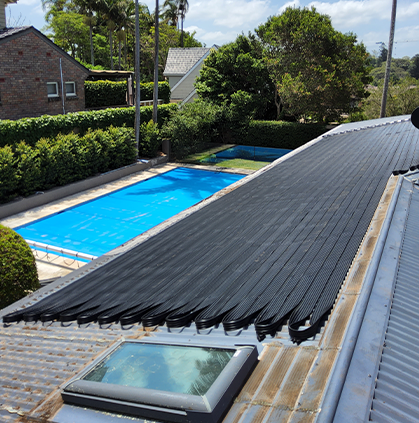
Solar pool heating uses a dedicated pump to circulate water through roof-mounted solar collector panels or strip matting.
As the water passes through the sun-warmed collectors, it absorbs heat and returns to your pool a little warmer. Do this all day and your pool will become warmer.
Most systems have a controller and temperature sensors that only push water to the panels when they can heat your pool.
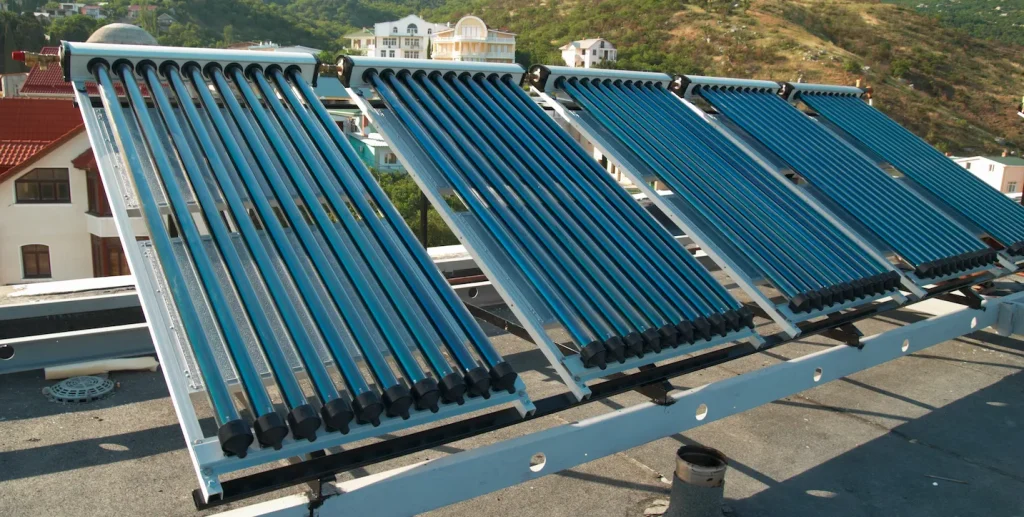
Image dovapi on Freepik
Now, with this kind of process, what are the advantages of using a solar pool heating system?
Pros of Solar Pool Heating
Solar pool heating gives you five advantages as a pool owner, all from how the system taps free sunlight:
- Near-zero running costs — Unlike systems that heat with electricity, you’re paying only to move the water to your roof. Even with a small booster pump, it’s usually under $1 a day.
- Low maintenance — Solar pool heating is a robust, set-and-forget system with no moving parts to burn out. With UV-stabilised and cockatoo-resistant panels, your only job is keeping the pool filter clean.
- Long lifespan — A good solar system is a long-term asset. Heat pumps may need replacement every 8–12 years due to compressor failure, but premium solar panels last 20–25 years.
- Completely silent — Roof panels have no moving parts, so there’s no mechanical hum or vibration. This matters for homes near fences or bedrooms. It lets you heat water all day without disturbing neighbours.
- Eco-friendly — Solar pool heating offers clean, carbon-free energy during daylight hours that reduces electricity bills. It’s a sustainable, low-impact choice for energy-efficient homes.
Cons of Solar Pool Heating
What are the disadvantages of using a solar pool heater that make you question if you want to choose the system?
- Weather dependence — The system relies on forecasts. While collectors capture diffuse energy on cloudy days, they often can’t raise the pool temperature. The pool stays warm only when the sun shines.
- Roof space is non-negotiable — Solar works best only when at least 80% of the pool’s surface is covered. If you don’t have that, you’re left with an undersized system. That way, your pool won’t get warm enough.
- Limited seasonal use — Solar helps you swim longer but isn’t a year-round cure. In winter, the air is too cold to heat the roof pipes. If you want to swim in June or July, solar alone can’t beat the heat loss.
- Lack of precise temperature control — With solar, you can set 28°C on an automatic controller, but it only hits that mark when solar energy is available. Clouds defeat you. It’s less reliable than mechanical heating.
How a Pool Heat Pump Works
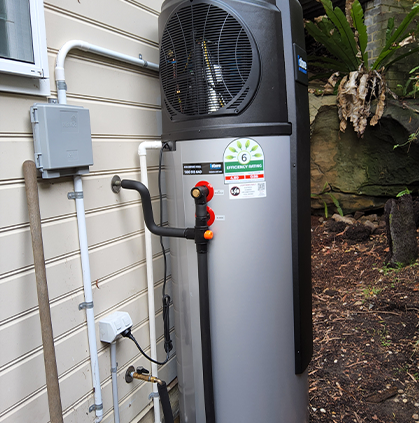
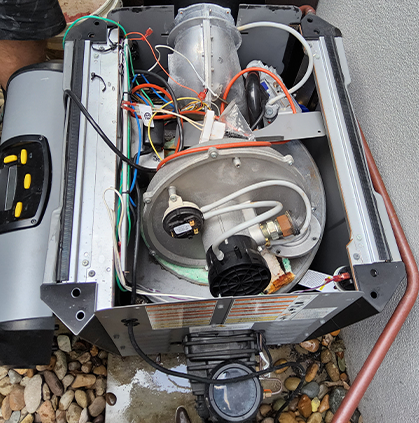
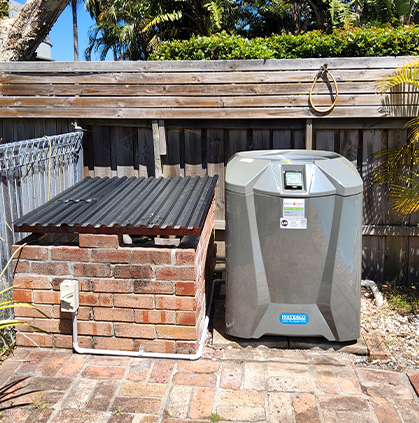
A pool heat pump is an electric device that pulls heat from the air around you and moves it into your pool water with a refrigerant cycle. It keeps your water at a set temperature, no matter the weather.
Think of it as a reverse-cycle air conditioner for your pool. A fan pulls in outside air, which passes over an evaporator coil with refrigerant. The refrigerant soaks up heat and turns into a gas.
The gas is compressed, which boosts the heat, and then that heat is released into your pool water through a heat exchanger.
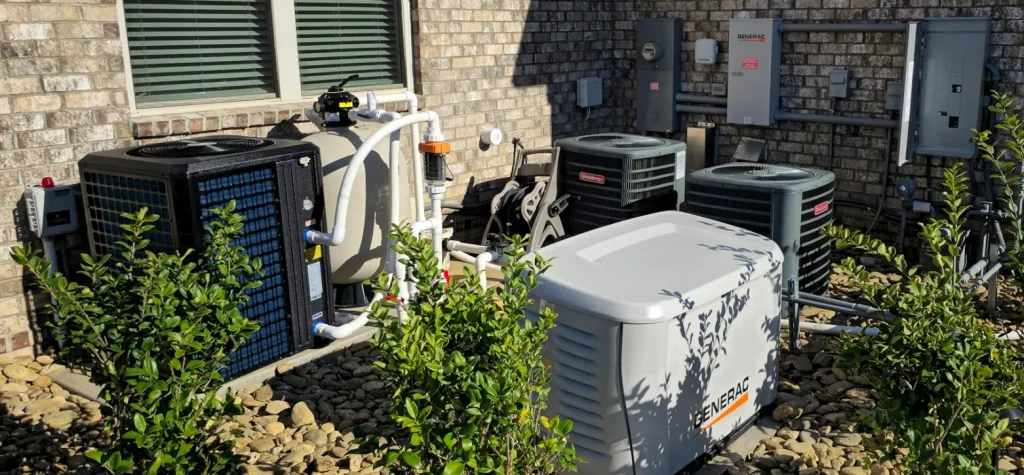
Image by Amazon
Pros of Heat Pump Pool Heating
Now, what are the advantages of the heat pump pool heating?
- Reliable year‑round swimming — A heat pump doesn’t care if it’s July or if Sydney has three cloudy weeks. As long as the outside temperature stays above about 7°C, your pool stays warm. This way, a heat pump lets you swim 365 days a year.
- No roof space required — A heat pump sits on the ground near your pool filter and pump. It’s ideal for homes with small roofs, complex lines, or multiple storeys, and needs no roof collectors.
- Precise temperature control — Set your target temperature and the heat pump keeps it steady. This is a big upgrade over solar’s weather‑based method, which is ideal for a spa or fixed water temperature for exercise.
- High energy efficiency with inverter technology — Modern heat pumps use inverter compressors to turn electricity into heat efficiently. By speeding up and slowing down smoothly, they use far less power.
- Compact and flexible to install — A modern heat pump needs about a square metre of ground space and can fit in narrow side passages. It doesn’t need a north‑facing roof and works almost anywhere with good airflow.
Cons of Pool Heat Pumps
Here are some of the disadvantages of relying on a heat pump for your pool heating:
- Higher running costs — Your heat pump uses electricity for its compressor and fan. So, you’ll probably see your monthly bill go up a bit, even with inverter technology. Over time, this costs more than a solar heater.
- More complex parts — Your heat pump has a fan motor, compressor, and sensors that need regular check-ups. So, getting it serviced professionally is key to keeping it running well. This costs money over time.
- Shorter lifespan — Solar panels can easily last 20 to 25 years. A heat pump, though, usually lasts about 10 to 15 years. You’ll probably replace a heat pump twice for every solar system you have over the life of your pool.
- Not “instant” heat — Heat pumps warm water slowly. It can take 24–48 hours to get back to ideal pool temperature after being turned off. They’re good for keeping a steady heat, but not for quick heating.
Key Differences Between Solar Pool Heaters and Heat Pumps
Seven key differences separate solar pool heating from heat pumps, shaping which system suits your swimming habits and budget:
1. Energy Source
This is a significant difference between solar pool heating and heat pumps. Solar pool heating uses the sun’s thermal energy, while heat pumps use grid electricity to transfer heat from the air.
Solar systems capture heat via roof absorbers, with costs tied to collector area. Heat pumps use an electric motor to heat water, with costs based on the unit and kilowatt-hour usage.
2. Upfront Costs
The cost of setting up solar pool heating is about $3,000 to $7,000 for a regular pool in Sydney. This includes $2,000 to $4,000 for the solar panels, $500 to $1,500 for plumbing, and $500 to $1,500 for labour.
Heat pumps cost $4,500 to $9,500 upfront. This comes from pricier units at $3,000–$6,000, extra electrical work at $1,000–$2,000, and plumbing integration at $500–$1,500.
3. Running Costs
Your solar system needs a small pump to push water to your roof collectors. It uses 0.5 kW to 0.75 kW per hour. Running it 6 hours a day solar pool heating cost about $0.80 to $1.40 daily. Over a 6-month season, that’s $150 to $250 per year.
A heat pump’s cost depends on its Coefficient of Performance (COP), which shows how much heat you get for the electricity you use. It costs about $6 to $15 a day to run, using 3–5 kW for several hours.
4. Temperature Control
When comparing solar pool heaters and heat pumps, think about temperature control. Heat pumps can keep your pool steady at 27–30°C with 1°C accuracy.
Solar heaters aren’t as good at temperature control. They can warm water 5–10°C above the air on sunny days, but daily changes of 3–5°C are common.
Most solar systems just have “On/Off” or a simple “Set Point,” but they can’t compensate for low sunlight.
5. Heating Performance
On a sunny day, your pool can warm up by 5°C just from the sun. On hot summer days, those collectors can even add 0.5°C to 1°C every hour. And if your pool is cold, it’ll take about one to four days of sunshine to get it to 26°C.
A heat pump warms your pool water more gradually, usually by 0.25°C to 0.5°C each hour. It’s not as fast as solar, but it works non-stop. It can keep your pool at 28°C–29°C, even if it rains for a whole week.
6. Installation Requirements
Roof orientation matters for pool heating. A north-facing roof with 30–50 m² of clear space favours solar. East or west-facing roofs require 15–20% more collector, increasing cost.
In such cases, a heat pump is a better choice but make sure you size your pool heat pump right. If the space is very narrow (less than 1 metre wide), it can block air from moving, which reduces heat pump performance.
7. Lifespan
Solar collectors last 15–20 years with little maintenance. No moving parts means fewer issues. Conversely, heat pumps last 10–15 years before needing compressor or heat exchanger service.
So, for long-term homeowners, solar offers better value due to its durability. And if you might move within a decade, a heat pump’s upfront cost and convenience might be a better balance.
Which Option Is Better for Your Pool?
Image by Amazon
Your ideal pool heating system depends on your swimming habits, location, and property:
Choose Solar Pool Heating If…
- You swim seasonally — Does your pool close for winter? Solar provides the heat you need without ongoing electricity costs; you don’t need a year-round heat pump.
- Your roof is north-facing — Solar works best with a clear, north-facing roof, no shade, and minimal competing solar PV.
- You want the lowest running costs — Over 20 years, solar can save tens of thousands compared with a heat pump.
- Sustainability matters — Solar pool heating is the most environmentally responsible option.
Choose a Heat Pump If…
- You swim year-round — For winter laps or guests, a heat pump provides steady warmth.
- Your roof isn’t suitable for solar — Ground-installed heat pumps are favoured when there is shade, a south-facing orientation, existing solar panels, or complex roof shapes.
- You want precise temperature control — Automatic, exact temperature is a heat pump strength.
- You have a spa or therapy pool — Spas need consistent high temperature (35–38°C) on demand. Solar can’t reliably deliver this.
Can You Combine Solar Pool Heating and a Heat Pump?
Yes. If you want the best of both, blend solar pool heating with a heat pump. This hybrid setup is the smartest long‑term investment.
Solar handles sunny months at almost no cost. The heat pump covers cloudy days, shoulder seasons, and winter, keeping your pool swim‑ready.
The systems take turns. In summer, the heat pump barely runs. Solar does the work for free. In autumn and winter, the heat pump takes over, but sunny days let solar cut the pump’s workload.
If you have rooftop solar PV, the pairing gets stronger. Run the heat pump during daylight when panels generate electricity. Or try comparing gas vs electric pool heater first to see the big picture.
FAQ About Solar Pool Heating vs Heat Pump
A few questions Sydney homeowners keep asking when they’re weighing these two options.
Is solar pool heating cheaper to run than a heat pump?
Yes, heating your pool with solar is cheaper to run, less than $1 a day. A heat pump, on the other hand, will cost you about $250 to $750 a year for electricity. So, over ten years, solar heating saves you a lot of money.
Is a heat pump better for winter?
Yes. Heat pumps are better in winter because they concentrate low‑grade heat into high‑grade warmth. Even at 10°C outside, they can heat a pool. Inverter technology helps them “outrun” the cold, making them ideal when other methods fail.
Do I need roof space for solar pool heating?
Yes. To heat your pool effectively, match your solar collector area to 80%–100% of the pool’s surface. A 32 m² pool needs about 30 m² of clear, north‑facing roof. Without this space, the system won’t be able to grab enough energy.
Which system lasts longer?
Solar panels last longer for your home. Your solar setup is a 20‑to‑25‑year investment. Panels just sit on your roof, so not much can break. Heat pumps, on the other hand, have parts that wear out, so you’ll probably replace one twice while your solar system is still working.
Conclusion
It’s time to choose between solar pool heating and heat pumps based on where you live, your budget, and how you swim.
Solar works best if you’re a seasonal swimmer who wants to keep long-term costs down. Heat pumps fit better if you swim all year and want reliable warmth, precise control, and the option to install on the ground.
Still unsure? Call Lightning Bult at (02) 9905 8800 or visit our pool heating services page to book a free site assessment.