




Sydney homeowners often search how to heat an above ground pool after a freezing May plunge ruins the weekend. The pool looked easy. The water had other plans.
18°C is not a fun swim. The walls are out in the open, and autumn wind takes your heat away overnight.
But you can fix it. Gas, heat pumps, and solar heating all work. But match the heating system to your pool size. And this guide breaks down Sydney costs before professional pool heating installation. Read on!
Can You Actually Heat an Above Ground Pool?
You can heat an above-ground pool. Heat pumps, solar heaters, gas units, or thermal blankets all work. But, your pump, plumbing, and pool volume must suit the job.
It doesn’t matter if you have an inflatable, steel-frame, or permanent above-ground pool. You can heat it.
It all comes down to water volume. Some above ground pools are small and heat up fast. Others hold a ton of water and need the right setup.
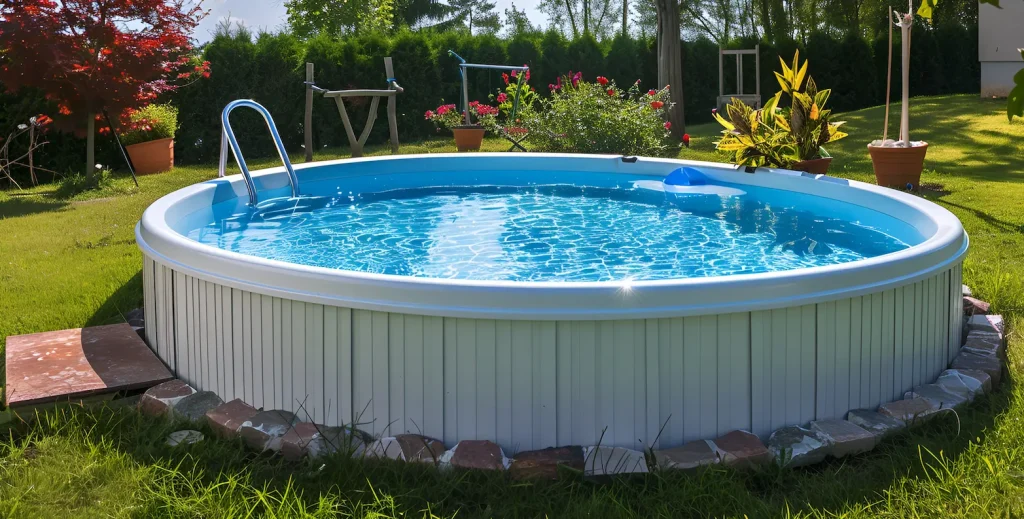
Image: amazon.com
Most above ground pool heating options fall into three groups:
- Mechanical heaters, like inverter heat pumps and gas units.
- Active solar heating, where the pump sends water through solar collectors.
- Passive heating, mostly thermal solar blankets that sit on the surface and hold heat in.
The flow rate is what matters for those heating systems. Most small pool heaters need your filtration pump to move about 40 to 65 litres of water every minute before the heater’s flow switch will even turn on.
A regular sand filter on a metal pool usually has enough muscle to handle that. But the little cartridge pumps that come with cheap inflatable pools? They just can’t handle it.
And low flow doesn’t just slow down a heater. It can stop it. The unit tries to protect itself, so it turns off, throws an error, or cycles all weird. That happens when there’s not enough water moving through the heat exchanger.
Start With a Solar Pool Cover (Before You Buy a Heater)
This is true. A solar pool cover should be the first upgrade for almost every above ground pool. Buy a mechanical heater before a blanket, and you’re basically running ducted heating with every window wide open.
These blankets are made of a heavy-duty, bubble-wrap-style material that works two shifts.
During the day, those pockets help collect solar warmth. At night, the blanket becomes a physical lid over the water, cutting the evaporative heat loss that steals most of your pool temperature.
On clear, sunny days, a 400-micron cover can raise water temperature by about 6–8°C. In peak summer, that passive gain is often enough to keep an above ground pool comfortable without switching on a heater.
Plus, the cost is low compared with any powered heating system. Basic above ground pool covers sit around $150 to $450, depending on pool size and material thickness.
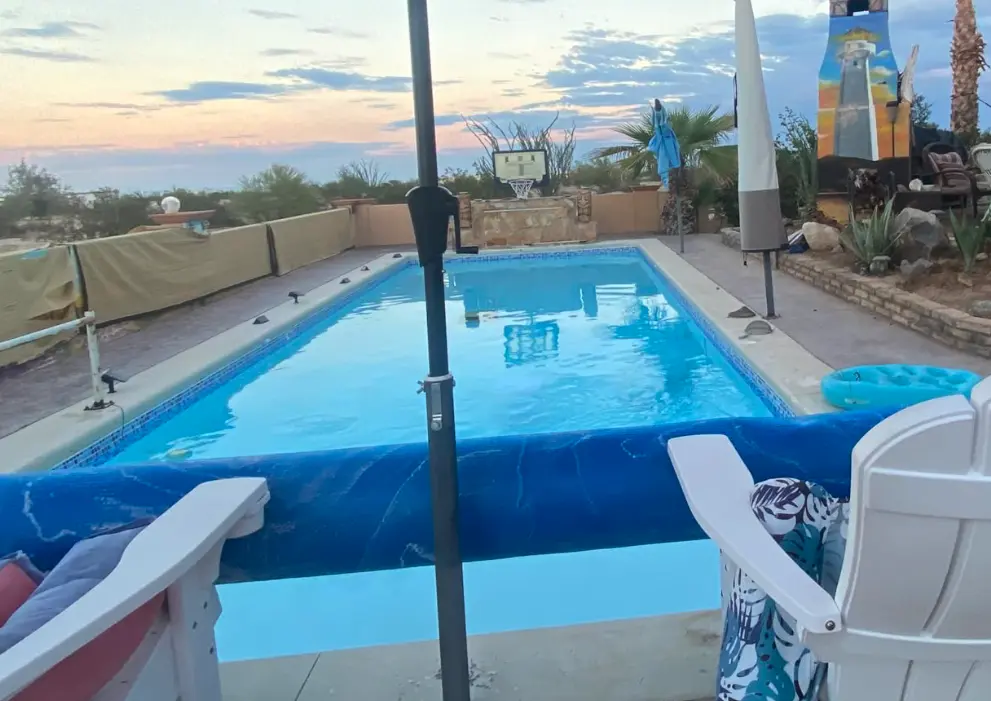
Image: amazon.com
But keep in mind that a cover won’t save a cold pool on grey afternoons. It won’t turn a windy Sydney July into swimming season either.
Still, even if you get a heat pump, gas heater, or solar pool heating later, the blanket is a must. Without a cover, your heater just keeps reheating water that cooled down overnight.
Pair the two and you can cut heating costs by about 30 to 50%, because the heat you paid for stays in the pool.
The Best Ways to Heat an Above Ground Pool in Sydney
If a solar cover isn’t warming your pool enough, you might want to look into heat pumps, solar pool heaters, or gas heaters. The right choice depends on how you like to swim.
Heat Pump: Best All-Round Option
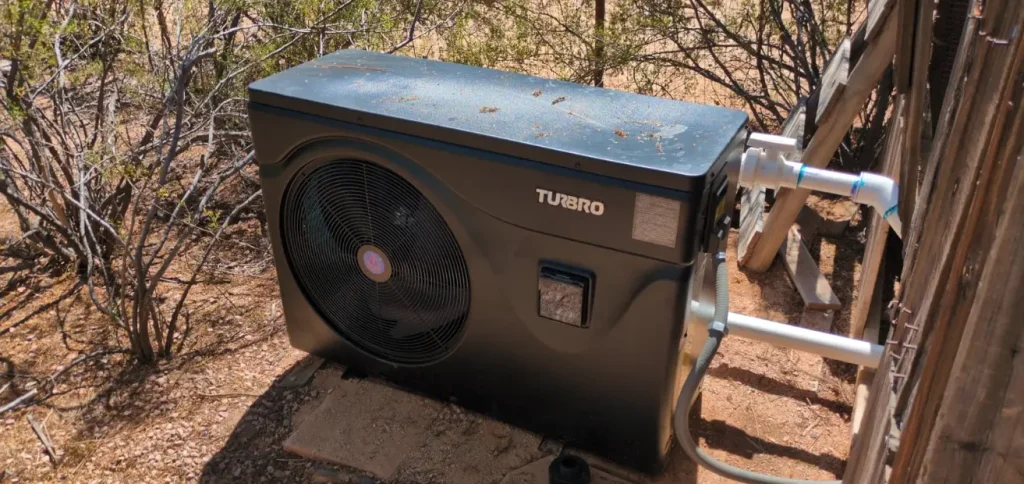
Image: amazon.com
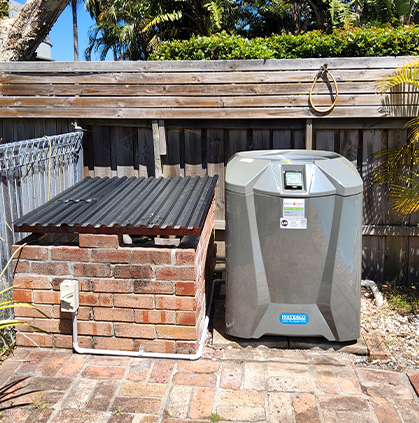
A heat pump doesn’t create heat. It pulls in the air around it, compresses it, and warms your pool water. For most Sydney backyards, this is easily one of the best pool heating options.
But you might have heard that heating an above ground pool will make your electricity bill high. Well, that was true when everyone used old fixed-speed pumps that ran at full power all day.
Modern inverter units are different. They shift gears automatically and hit a Coefficient of Performance (COP) of 7 to 22. One kilowatt goes in, and up to twenty-two come out.
Sydney’s climate is perfect for this. The machine works great as long as the air stays above 10°C, which our coastal suburbs rarely drop below.
And what about costs? A 5 to 7 kW heat pump for a 10,000 to 20,000-litre above-ground pool usually costs 10 to 45 cents per hour to run.
Of course, it varies. It depends on wind, whether you use a solar blanket, and your ideal pool temperature. And running the machine during off-peak hours on a Time-of-Use tariff will lower your bill.
But, before you buy, remember that your pool pump needs to push at least 30 to 40 litres of water every minute, or the heater won’t turn on. Most above-ground pumps can do this, but check your filter label to be sure.
Solar Pool Heating System: Best for Low Running Costs
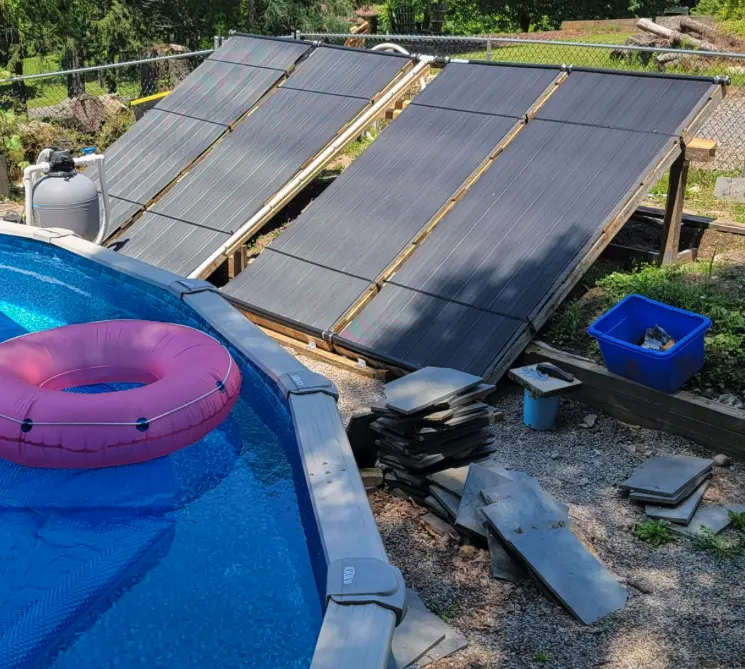
Image: amazon.com
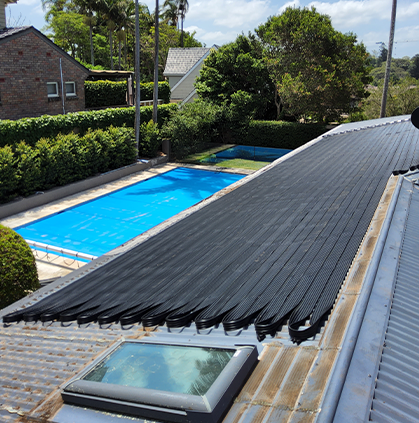
Solar is the cheapest option for heating a pool over time. Nothing else is even close if you have a roof that faces north and swims from September to May.
Water flows from your filter to the roof collectors, soaks up the sun, and heads back into your pool.
Your daily running cost with solar pool heating in Sydney is close to zero. You’ll only pay about $250 a year for the extra electricity to run the pump. That’s it.
For a standard 40,000-litre pool in Sydney, expect to pay $6,000 to $9,000 upfront. This covers the panels, pump, controller, and a 25-year warranty on the rigid panels.
You will need plenty of roof space, though. While Australian Standard AS 3634:2022 sets the rules, experts recommend covering 80–100% of your pool’s surface area for the best results in Sydney.
You win back the investment in two years compared to burning gas or electric with this above ground pool heating. But June and July will fail you.
Sydney’s winter sun only hits 3 to 3.5 kWh/day, so it can keep a warm pool going, but it can’t heat up a freezing one during a cloudy week.
It buys you four extra months of swimming from spring through autumn. Want to swim in July? Buy a mechanical heater instead.
Gas Pool Heater: Best for Fast Heating On Demand
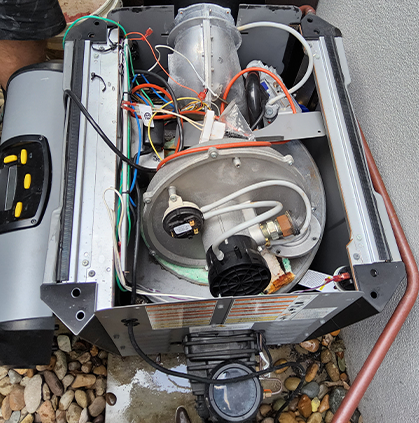
Gas wins on raw speed. A 150 MJ/hr unit heats your 15,000-litre pool by 10°C in just five to six hours, even in freezing air or heavy overcast skies.
No other above ground pool heating matches that performance.
But running costs of gas pool heater Sydney are high. You’re looking at about $5.25 to $10.50 per hour, based on Jemena’s rates of 3.5 to 7 cents per MJ, with 87% efficiency.
With standard rates, it’s more like $9 an hour, so budget for $800 to $3,000 a year. But what about those “$4 to $6 per hour” claims? You’d need the cheapest possible contract to get those numbers.
Before you buy, check if natural gas mains are available. In big parts of the Northern Beaches like Avalon, you’ll rely on LPG bottles instead of Jemena’s gas grid.
LPG costs you 40% to 60% more per MJ. So your $5.25 hourly bill jumps to $7.35 or $8.40. Plus, heaters aren’t one-size-fits-all. You’ll need a conversion kit and a new regulator to run LPG safely.
Installation will run you $3,500 to $6,000 for a 150 to 200 MJ setup. And you have to hire a licensed gas fitter to follow AS/NZS 5601.1:2022 and get a Compliance Certificate.
Also, make sure a licensed electrician handles all the pump and automation wiring to meet AS/NZS 3000:2018.
Heating Method Comparison: Which Is Right for Your Pool?
Use this table as your practical guide. These numbers are based on a 10,000–20,000 L above-ground pool with a solar cover and standard electricity rates.
| Heating Method | Upfront Cost | Running Cost | Heat-Up Speed | Sydney Suitability | Best For |
|---|---|---|---|---|---|
| Inverter Heat Pump | $4,500–$9,500 installed | $60–$130/month | 12–16 hrs (15kL, 10°C rise) | High — efficient above 10°C | Daily swimmers, year-round value |
| Solar Collector | $3,000–$7,000 installed | $50–$100/yr | Slow — sunshine dependent | High (Sept–May); limited June–July | Spring–autumn use, lowest bills |
| Gas Heater | $3,000–$6,000 installed | $5.25–$10.50/hr (natural gas) | 5–6 hrs — fastest | Unrestricted — any season | Weekend entertaining, quick heat |
| Solar Cover | $50–$200 | $0 | +8°C on sunny days | Moderate — summer season only | Every pool owner, every system |
For most Sydney above ground pool owners, the strongest setup is an inverter heat pump with a high-quality solar cover. The heat pump creates reliable warmth. The cover keeps that warmth in the pool.
Gas suits the weekend entertainer. Solar pool heating suits the low-running-cost household with good roof space. A solar cover suits everyone, even if another heater is installed later.
For a deeper system-level comparison, you can read the heat pump sizing guide before committing to the best-suited type for your needs.
Installation Tips for Above Ground Pool Heaters
So, how to heat an above ground pool right? You can follow these tips:
- Plumb only on the return side — Water should flow from the pool to the pump, through the filter, into the heater, and back to the pool. Never put it on the suction side, or you’ll starve the pump and ruin the system.
- Install a three-valve bypass loop — This lets you control how much water goes into the heater. It also makes it easy for a technician to service it later without draining your whole pool.
- Match your hose fittings — Above-ground pools usually use flexible 32mm or 38mm hoses. Check that the heater’s inlet and outlet sizes match your pool’s fittings before you buy. Or swap them for 50mm rigid PVC pipe to handle flow and pressure reliably.
- Keep proper clearance for airflow — Heat pumps need room to breathe. Top-discharge and side-discharge models have different airflow patterns. Top-discharge units generally need 1.5m to 2m of clear vertical space above the fan. Side-discharge units need clear paths in front of the fan to stop cold air from recirculating.
- Hire a professional for gas and hard-plumbed setups — Don’t risk a DIY disaster with gas or high-voltage electricity. In NSW, a licensed electrician must certify wiring and bonding under AS/NZS 3000:2018.
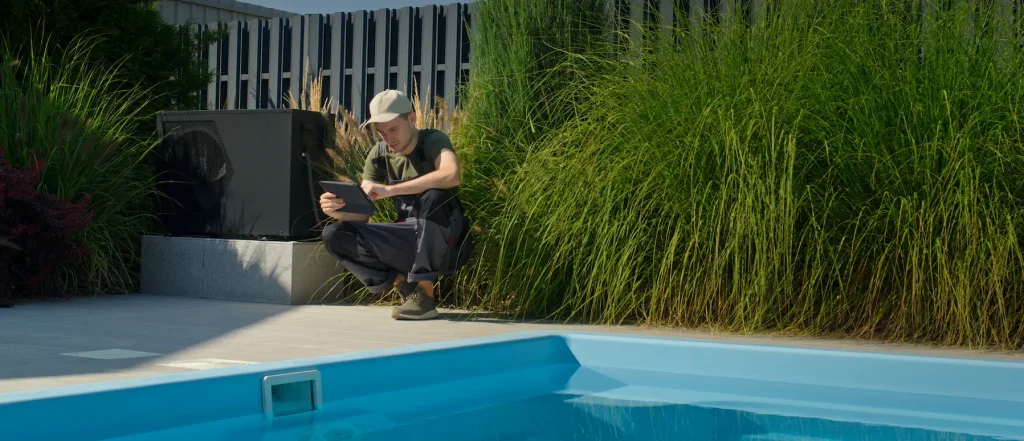
Image: amazon.com
FAQs about Heating an Above Ground Pool
Here are the questions people ask most about heating your above-ground pool:
Can a heat pump work with an inflatable above ground pool?
Usually no. Inflatable pool filters push under 35 L/min, but compact inverter heat pumps need 50 to 65 L/min. Use a solar cover instead. And if you have a steel-frame pool with a sand filter, check if your pump’s flow rate matches the heater before buying.
How long does it take to heat an above ground pool?
A 300 MJ gas heater pushes your 20,000-litre pool up 12°C in 4–5 hours. A 13 kW heat pump needs 18–24 hours for the same jump. Leave a 400-micron blanket off overnight, and evaporation wastes hours of runtime.
What temperature can I heat my above ground pool to?
24–26°C is comfortable for swimming, while 28°C is ideal for shoulder seasons. Some gas heaters reach 35°C for spa-like use, though costs rise rapidly. That’s why choosing a pool heater that matches your needs matters.
How much does it cost to heat an above-ground pool in Sydney?
For a 32,000-litre pool: heat pumps cost $110–$220/month (with blanket), gas $200–$550/month (weekend use), and solar $25/month. Costs depend on shading, wind, and local utility rates.
Do you need a licensed installer for an above ground pool heater?
No, for a solar cover. But for a heat pump, yes. Socket-outlets can’t be within 1.25m of the pool edge. And pool equipment power points must be fixed and RCD isolated. For a gas pool heater and roof-mounted solar collectors? You need a licensed gasfitter.
Conclusion
Heating your above ground pool in Sydney works when the system fits your pool. But start with a solar cover to cut heat loss.
Solar costs the least to run and gas heats the fastest. An inverter heat pump gives the best balance.
Not sure which above ground pool heater is right for you? Lightning Bult‘s pool heating team can check your pool, recommend the right system, and install it across Sydney.